March 9, 2026
A warranty team at a mid-size agricultural equipment manufacturer in Ohio told us something last year that stuck. They had been running their warranty operation on SAP, a homegrown dealer portal, and a rotating cast of spreadsheets for over a decade. Claims volume was around 80,000 per year. And they were losing, by their own estimate, somewhere between $4 million and $6 million annually to a combination of overpaid claims, unrecovered supplier costs, and fraud that nobody had the bandwidth to investigate.
That is not an unusual number. It is actually on the low end.
Across the US manufacturing sector, warranty costs have been climbing steadily. Ford alone accrued $6.29 billion in warranty reserves in 2024, a 33% jump from the year before. GM followed with $4.62 billion, up 41%. These are not small fluctuations. They represent a structural shift in the cost of standing behind the products these companies build.
What is changing, though, is how a growing number of manufacturers are responding. Instead of throwing more auditors at the problem or squeezing dealer labor rates, they are deploying AI across the warranty lifecycle. And the results are not incremental. Manufacturers that have adopted AI across claim validation, fraud detection, and supplier recovery are reporting warranty cost reductions of 20% to 30% within the first 12 to 18 months.
This article breaks down exactly where those savings come from, how the technology works in practice, and what separates manufacturers who get real ROI from those who end up with another shelfware investment.
Before we talk about AI, it helps to understand why warranty costs have become such a pressing issue right now. The answer is not just “products are getting more complex,” although that is part of it. There are several forces converging at once.
First, warranty accruals across US manufacturers hit record highs in 2024. According to Warranty Week’s annual tracking of over 1,400 US warranty-issuing manufacturers, the average company spent 1.33% of product revenue on warranty claims last year. For automotive OEMs, that number sits closer to 2.5% to 3%. For a manufacturer doing $500 million in annual revenue, that is $6.5 million to $15 million flowing out the door every year in warranty costs alone.
Second, labor costs are rising. New York’s retail labor rate law, which took effect in September 2024, requires OEMs to reimburse warranty labor at retail guide rates rather than discounted flat rates. Other states are considering similar legislation. Every inflated labor claim in your network now carries a higher per-hour cost.
Third, product complexity is accelerating warranty exposure. Electric vehicle components, software-defined systems, and embedded electronics create failure modes that did not exist five years ago. The warranty infrastructure that handled a gasoline engine and a mechanical transmission was never designed to manage battery degradation claims, OTA update liability, or sensor calibration disputes.
And fourth, fraud and leakage remain stubbornly persistent. Industry estimates consistently place fraudulent or inaccurate warranty claims at 3% to 15% of total claim value. For most manufacturers, the real number is somewhere in the middle, quietly draining margin every quarter.
The bottom line: warranty is no longer a back-office cost center that finance reviews once a quarter. It is a strategic cost driver that directly impacts EBITDA, dealer relationships, and product quality feedback loops. And the manufacturers gaining ground are the ones treating it that way.
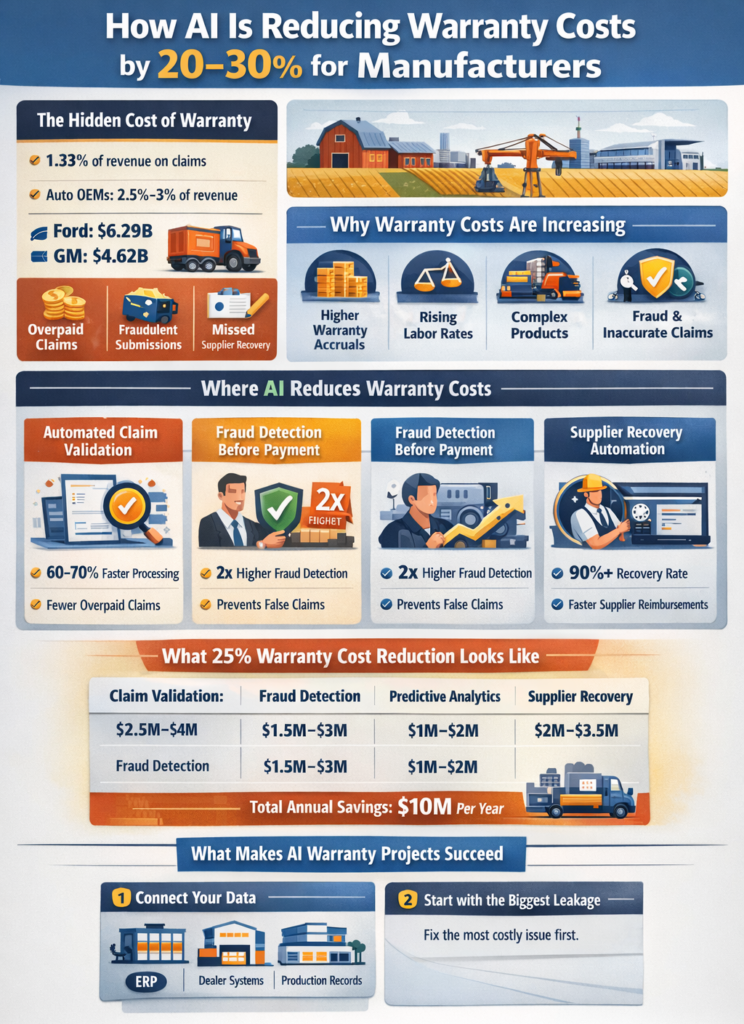
When manufacturers talk about “using AI for warranty,” the phrase is broad enough to mean almost anything. But the cost reductions in the 20% to 30% range come from four specific operational areas. Each one addresses a distinct source of financial leakage.
This is where the largest, fastest savings appear. In most warranty operations, claims are reviewed by human adjusters who check submitted data against warranty policies, labor rate tables, parts catalogs, and coverage windows. The process is slow, inconsistent, and dependent on the experience level of whoever happens to be reviewing that particular claim.
AI-powered validation engines change the math entirely. Every incoming claim is checked automatically against your warranty policies, flat-rate manuals, parts master data, and historical claim patterns. Claims that meet all policy criteria are approved without human touch. Claims that deviate are routed to a review queue with the specific deviation flagged.
The impact is twofold. Processing time drops dramatically. Organizations that have deployed AI validation report cycle time reductions of 60% to 70%, with some achieving near-real-time adjudication for straightforward claims. But more importantly, the consistency of enforcement improves. When every claim is validated against the same rules, the over-approvals that bleed margin in a manual process simply stop happening.
One automotive equipment manufacturer reported resolving claims 44% faster with AI-assisted validation while simultaneously catching policy exceptions that had been slipping through for years. That combination of speed and accuracy is something a manual process cannot replicate at scale.
Traditional warranty fraud detection is an oxymoron. Most manufacturers discover fraud during periodic audits, which happen quarterly or annually. By then, the money is already gone. Recovery is expensive, slow, and rarely complete.
AI flips this model. Machine learning systems analyze each incoming claim against the full historical dataset in real time. They look at labor time relative to the repair code baseline, parts usage patterns relative to the failure type, dealer submission behavior over time, VIN-level claim frequency, and dozens of other signals. Claims that deviate from expected patterns are flagged before payment is released.
The kinds of fraud this catches are not the obvious ones. It is the dealer whose average labor time for a specific repair code runs 22% above the regional mean, consistently, over 14 months. It is the VIN that shows up at three different service centers with near-identical transmission complaints within 60 days. It is the parts claim where the billed component does not match the vehicle’s production BOM for that model year.
Manufacturers deploying pre-payment fraud detection report catching fraudulent or inaccurate claims at more than double the rate of manual review processes. When you combine that detection rate with the elimination of post-payment recovery efforts, the financial impact compounds quickly.
This lever operates upstream of the claims process entirely. Instead of waiting for warranty claims to pile up before identifying a product quality issue, AI monitors claim data, sensor telemetry, and field service reports in real time to spot emerging failure patterns early.
GM has been a notable example in this space. The company deployed predictive analytics to correlate warranty claim trends with production variables, usage data, and design specifications. The system enabled early detection of quality defects before they escalated into large-scale field issues, reducing both the volume and the cost of downstream warranty claims.
Ford took a different angle, developing a predictive maintenance model for fleet vehicles that could forecast equipment failures up to 10 days in advance. The initiative reportedly prevented over 122,000 hours of vehicle downtime and saved an estimated $7 million through proactive interventions. Separately, Ford’s Integrated Vehicle Systems project enabled remote reprogramming of vehicle electronics, helping the company avoid over $100 million in module replacement costs over three years.
For OEMs in agriculture, construction, and industrial equipment, the application is even more direct. Sensor data from equipment in the field feeds AI models that predict component failure before it triggers a warranty claim. A hydraulic pump that is trending toward failure can be serviced proactively during scheduled maintenance, avoiding both the warranty cost and the customer downtime.
The warranty cost reduction here is structural, not just operational. You are not processing claims faster or catching fraud. You are preventing the failure that would have generated the claim in the first place.
This is the most overlooked source of warranty cost savings, and for many manufacturers, it represents the single largest opportunity.
When a warranty claim involves a defective component supplied by a third-party vendor, the OEM has a contractual right to recover that cost from the supplier. In theory. In practice, supplier recovery is one of the most broken processes in manufacturing warranty operations. Recovery claims are filed late. Documentation is incomplete. Disputes drag on for months. And for lower-value claims, the cost of pursuing recovery exceeds the recovery amount, so the OEM simply absorbs the loss.
AI changes this by automatically identifying supplier-liable claims at the point of adjudication, generating recovery documentation packages, and routing them directly to the supplier portal. The system tracks recovery status, escalates unresolved disputes, and reconciles payments against original claims.
Manufacturers running automated supplier recovery report recovery rates above 90%, compared to the 40% to 60% that is typical in manual operations. For a mid-size OEM processing $30 million in annual warranty claims where 30% involve supplier-liable components, the difference between a 50% recovery rate and a 90% recovery rate is $3.6 million in annual margin.
Every warranty AI vendor has a slide deck showing impressive numbers. The question for manufacturers is not whether AI can reduce warranty costs. The evidence is clear that it can. The question is what separates the deployments that deliver measurable ROI from those that stall after a proof of concept.
Based on what we see across OEM warranty operations, there are three differentiators that matter more than the AI model itself.
AI is only as useful as the data it can access. The manufacturers getting real results have invested in connecting their warranty data to their ERP parts master, dealer management system, production records, and where available, field telemetry data. If your warranty system operates as an island, disconnected from the data that validates whether a claim is accurate, no amount of machine learning will fix the problem.
This is not a small point. Many failed AI warranty pilots fail not because the model was wrong, but because the data layer was never connected. The AI flagged a claim as suspicious, but nobody could verify the flag because the parts data lived in SAP, the dealer history lived in a CRM, and the vehicle production record lived in a third system that nobody had API access to.
Manufacturers who try to deploy AI across the entire warranty lifecycle at once tend to stall. The ones who succeed pick the single process with the most obvious financial leakage and start there. For most, that is either claim validation (because the volume of over-approvals is highest) or supplier recovery (because the dollar amount left on the table is largest).
A focused deployment on one high-impact area can show ROI within 90 days. That creates internal momentum, budget justification, and organizational trust in the technology, all of which are necessary to expand into fraud detection, predictive analytics, and broader operational optimization.
Warranty AI that requires ripping out your current warranty management system, or your ERP, or your dealer portal, is not going to get deployed. The manufacturers achieving results are layering AI capabilities on top of their existing infrastructure through bi-directional API integration.
Pre-built connectors for SAP, Oracle, and Microsoft Dynamics are table stakes. The AI system should enhance what your ERP already does, not compete with it. Approved payments should post directly to your general ledger. Parts should validate against your live ERP parts master. Supplier recovery transactions should link to purchase orders in your existing procurement system.
Let us put specific numbers around the claim. For a manufacturer processing $40 million in annual warranty costs, a 25% reduction is $10 million back into margin. Here is how that typically breaks down across the four levers:
| Savings Lever | Mechanism | Typical Savings |
| Claim Validation | Policy enforcement stops over-approvals | $2.5M to $4M |
| Fraud Detection | Pre-payment flagging of anomalies | $1.5M to $3M |
| Predictive Analytics | Early failure detection reduces claim volume | $1M to $2M |
| Supplier Recovery | Automated recovery of supplier-liable costs | $2M to $3.5M |
These are not theoretical projections. They align with published results from manufacturers that have implemented AI-driven warranty management. Copperberg’s 2026 analysis of manufacturers with AI warranty systems reported operational cost reductions of 30% to 50%, with processing time reductions of 70% to 90%. A semiconductor manufacturer implementing AI-powered fraud detection across 11 global support centers achieved a 30% increase in agent productivity while processing over 100,000 transactions monthly.
The payback period for most warranty AI investments is under 12 months. For manufacturers with severe supplier recovery gaps or high fraud exposure, payback can occur in a single quarter.
Three years ago, AI in warranty management was a conference talking point. Today, it is an operational reality for the manufacturers that are pulling ahead. Several factors make 2026 the inflection year.
Warranty costs are not stabilizing. Ford’s Q2 2024 results made headlines when the company attributed an $800 million spike in warranty expenses to legacy vehicle issues. GM’s warranty accruals rose 41% in 2024. The heavy equipment industry set aside $6.59 billion in warranty accruals during 2023, a 13% increase year over year. These numbers are trending in one direction, and manufacturers without systematic cost controls will feel the pressure compound.
Regulatory complexity is increasing. Right-to-repair legislation, retail labor rate mandates, and evolving EV warranty requirements are adding layers of compliance that manual processes cannot handle consistently across a national or global dealer network.
And the technology has matured. Three years ago, warranty AI meant a custom-built machine learning model that required a data science team to maintain. Today, purpose-built warranty platforms embed AI into the claims workflow natively, with pre-trained models that learn from your specific data within weeks, not months.
The gap between manufacturers who have adopted AI-driven warranty management and those still running manual processes is widening. The early movers are not just saving money. They are building the data infrastructure and operational discipline that will define warranty management for the next decade.
See Where Your Warranty Operation Is Leaking
If your OEM processes 50,000 or more warranty claims per year and you suspect your operation is losing margin to inconsistent approvals, missed supplier recoveries, or undetected fraud, a 45-minute walkthrough of NextGen Warranty will show you exactly where the gaps are and what automated enforcement would recover.
Request a Live Demo at nextgenwarranty.com
Key Takeaways
Q: How much can AI reduce warranty costs for manufacturers?
Manufacturers deploying AI across claim validation, fraud detection, predictive analytics, and supplier recovery report total warranty cost reductions of 20% to 30% within 12 to 18 months of implementation. The largest savings come from automated policy enforcement (which eliminates over-approvals) and supplier recovery automation (which recovers costs that were previously absorbed). A 2026 industry analysis found operational cost reductions of 30% to 50% among manufacturers with mature AI warranty systems.
Q: Where do the biggest warranty cost savings come from when using AI?
The four primary savings levers are: (1) automated claim validation that enforces warranty policies consistently across every claim, eliminating the over-approvals that occur in manual review; (2) pre-payment fraud detection that catches duplicate claims, inflated labor, and mismatched repairs before money leaves the organization; (3) predictive analytics that identify product failures early, reducing the volume of claims; and (4) supplier recovery automation that increases recovery rates from under 60% to above 90% for supplier-liable components.
Q: How long does it take for AI warranty management to show ROI?
Most manufacturers see ROI within 12 months. For those with significant supplier recovery gaps or high fraud exposure, payback can occur in a single quarter. Focused deployments that target a single high-leakage process first can demonstrate measurable savings within 90 days, building the business case for broader expansion.
Q: Does AI warranty management require replacing our existing ERP system?
No. Purpose-built warranty AI platforms integrate with existing ERP systems through bi-directional APIs. Pre-built connectors for SAP, Oracle, and Microsoft Dynamics are standard. The AI layer enhances your existing infrastructure by adding claim validation, fraud detection, and analytics capabilities that your ERP was never designed to handle. Approved payments post directly to your general ledger, and parts validate against your live ERP parts master.
Q: What industries benefit most from AI-powered warranty management?
Any manufacturer operating a dealer warranty network benefits from AI-driven warranty management. Automotive OEMs see the highest absolute savings due to claim volume and rising per-claim costs. Agricultural equipment manufacturers benefit particularly from seasonal fraud detection and supplier recovery. Construction equipment OEMs gain from high-value claim validation and field-based service documentation. Industrial machinery manufacturers benefit from extended warranty period management and predictive maintenance integration.
Q: How does AI detect warranty fraud that manual processes miss?
Machine learning models establish dynamic baselines of expected behavior for each claim type, repair code, dealer, and vehicle model. They then score every incoming claim against those baselines in real time, flagging statistical anomalies before payment. This catches patterns that rule-based systems and human reviewers cannot detect at scale, such as a dealer whose labor times consistently run above the regional mean or a VIN that appears across multiple service centers with similar complaints. Manufacturers using AI fraud detection report catching suspicious claims at more than double the rate of manual review.
Book a 30-minute walkthrough tailored to your industry.
Schedule a Demo