May 22, 2026
When a dealer submits a warranty claim for a failed component, the OEM typically pays it. What happens next is where most OEMs lose significant money.
If the failed component came from a supplier under a warranty agreement, the OEM is entitled to recover some or all of that claim cost from the supplier. This is warranty supplier recovery. In practice, most OEMs recover far less than they are owed because the process is manual, deadline-driven, and organizationally disconnected from the claims workflow that generated the data needed to file the recovery.
The financial scale of this problem is substantial. According to Warranty Week‘s 2023 Warranty Claims and Accruals Report, US manufacturers paid out over $25 billion in warranty claims in 2022. Industry estimates suggest OEMs recover between 20 and 30 percent of eligible supplier recovery amounts in practice, leaving billions in potential recoveries unrealized each year.
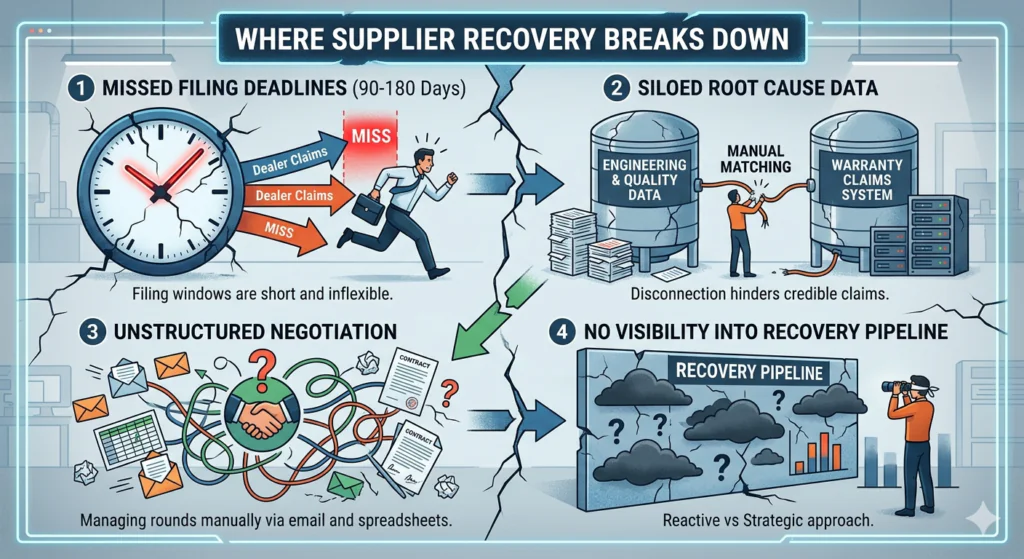
Most supplier agreements include a recovery filing window, typically between 90 and 180 days from the date of the original warranty claim. Miss that window, and the recovery right is forfeited. No exceptions.
In a manual recovery process, warranty teams receive claim data from one system, compile part numbers and failure codes, match them against supplier agreements in another system, draft recovery submissions, and file them through email or a supplier portal. By the time that sequence completes for any given claim batch, a meaningful share of claims has already aged past the filing deadline.
To file a credible supplier recovery claim, the OEM needs to connect the dealer’s warranty claim to a specific component, a specific supplier, and a documented failure mode. That requires root cause data, often sitting in an engineering system or a quality database that is not connected to the warranty claims management system.
When that connection does not exist in the software, someone has to make it manually. At scale, this is not feasible. Recovery claims that cannot be supported with root cause data are either not filed or are rejected by the supplier.
Supplier recovery is not a single transaction. Suppliers contest claims, request additional data, and offer partial settlements. Managing multiple rounds of negotiation across dozens of suppliers manually, through email threads and spreadsheets, is one of the most common reasons recovery rates stay low. Claims fall through the cracks, negotiation histories get lost, and agreed settlements go unconfirmed.
Most warranty teams cannot answer basic questions about their recovery pipeline: how much is outstanding, which suppliers are disputing claims, which claims are approaching deadlines, and what the expected recovery total is for the current quarter. Without that visibility, the team is reactive rather than strategic.
A 2022 Deloitte report on OEM after-sales operations found that supplier recovery is one of the most underinvested operational areas in OEM warranty organizations, despite being one of the highest-return improvement opportunities available.
The foundation of an effective recovery program is an automatic linkage between incoming warranty claims and the supplier agreements and part registrations that determine recovery eligibility. When a claim is processed, the system should flag it as a recovery candidate, identify the relevant supplier, and queue the recovery claim for filing, without manual intervention.
This is only possible when claims data, parts data, and supplier agreement data live in the same platform or are connected through a structured integration.
Every recovery claim should have a visible filing deadline calculated from the original claim date and the applicable supplier agreement terms. Teams should be able to sort and filter their recovery pipeline by deadline proximity. Claims approaching their filing window should surface automatically in work queues before they expire.
Supplier negotiations should take place within the claims system, not in email. This means suppliers can receive recovery submissions, respond with acceptances or disputes, and propose partial settlements through a structured workflow. Every exchange is logged against the claim record, creating an auditable negotiation history that supports escalation or legal action if needed.
According to Aberdeen Group’s Warranty Management Benchmark Report, OEMs using structured supplier recovery workflows recover 35 to 50 percent more per claim than those managing the process manually.
Recovery rates by supplier, by component category, by model year, and by claim type are the metrics that tell a warranty team where to focus. A supplier with a consistently high dispute rate on a specific part family is a different problem than one with a low filing rate due to root cause data gaps. Analytics that surface these patterns allow teams to address root causes rather than chase individual claims.
NextGen Warranty‘s supplier recovery module is built into the same platform that processes incoming claims, which means the claim-to-recovery linkage is automatic. When a claim is adjudicated, and a covered component is identified, the system generates a recovery claim under the applicable supplier agreement, including the deadline calculated from the claim date.
Suppliers receive recovery submissions through the platform and can respond, dispute, or propose settlements electronically. The system tracks up to three rounds of negotiation per claim and maintains a complete audit trail of every exchange. Recovery pipeline dashboards show outstanding balances, approaching deadlines, and dispute rates by supplier in real time.
OEMs using NextGen Warranty report supplier recovery rates that are significantly higher than industry averages, with one customer reporting a 40 percent increase in recovery amounts within the first quarter of implementation. Details are available on the NextGen Warranty supplier recovery page.
For an OEM paying $50 million per year in warranty claims, a conservative supplier recovery eligibility rate of 30 percent means $15 million in potential recoveries. Recovering 25 percent of that, a common result with manual processes, yields $3.75 million. Recovering 60 percent with an automated system yields $9 million. The difference is $5.25 million per year, recurring.
Supplier recovery is not a back-office administrative task. It is a direct driver of warranty cost, and it responds directly to the quality of the systems and processes managing it.
If you’re ready to take your supplier recovery in Warranty to the next level, book the demo today.
Warranty supplier recovery is the process where OEMs recover costs from suppliers for warranty claims related to defective components that are covered under supplier agreements. Instead of the OEM absorbing the full warranty cost, eligible expenses are reimbursed by the supplier.
OEM warranty cost recovery helps manufacturers reduce total warranty cost by shifting eligible costs back to suppliers. Without an effective recovery process, OEMs lose a significant portion of recoverable warranty expenses, directly impacting profitability.
OEMs often lose recovery revenue due to manual workflows, siloed data systems, missed filing deadlines, incomplete root cause documentation, and unstructured supplier negotiations. These inefficiencies lead to low recovery rates.
Recovery rates vary by industry and process maturity, but many OEMs recover only 20–30% of eligible supplier recovery amounts when using manual systems. Automated systems can significantly improve this percentage.
Book a 30-minute walkthrough tailored to your industry.
Schedule a Demo