March 2, 2026
Most warranty management system evaluations start the same way. Someone on the aftermarket team gets frustrated enough with claim backlogs or supplier disputes to finally push IT into a formal RFP. Tavant Warranty shows up early in that process, mostly because it has been around long enough to earn a spot on analyst shortlists and has strong brand recognition in the North American OEM space.
But brand recognition and the right fit for your operation are two very different things. Tavant was built on top of the Salesforce platform, which is a genuine architectural decision with real downstream consequences for pricing, integration flexibility, and how your team actually experiences the software day to day. NextGen Warranty Management System takes a fundamentally different approach, one designed from the ground up to serve mid-to-large OEM manufacturers without tying your entire warranty ecosystem to a third-party CRM platform.
This comparison is written for operations and aftermarket leaders who are already past the research phase. You know you need a purpose-built warranty management system. You are trying to decide which one actually fits how your dealer network, supplier recovery process, and internal teams work. That is the lens this article is written through.
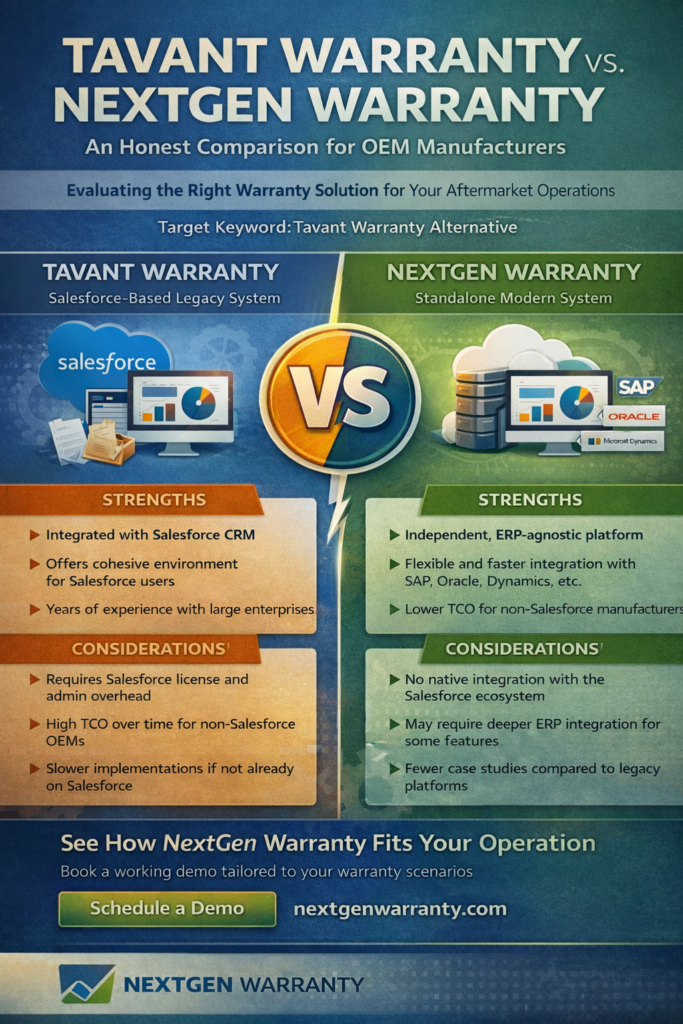
Tavant Warranty On-Demand is native to Salesforce. That is the core of what it is. This is worth understanding before evaluating any feature set, because the platform it runs on shapes every downstream consequence. It shapes what you pay, what you can configure without developer involvement, and how your ERP integration behaves.
If your organization already runs Salesforce for CRM, service, or sales operations, Tavant can feel like a natural extension. The same login, familiar UI conventions, and existing Salesforce admin resources can manage it. For large enterprises already deep in the Salesforce ecosystem, that coherence has genuine value.
But if your OEM operation runs on SAP, Oracle, or Microsoft Dynamics and has no meaningful Salesforce footprint, adopting Tavant means adopting Salesforce as a prerequisite. You bring with it a full layer of licensing costs, admin overhead, and integration complexity underneath your warranty system. That is a significant architectural decision being made by default, not by design.
| One OEM aftermarket director summarized it well during an industry panel: the moment your warranty management system requires you to also manage a CRM license, your total cost of ownership calculation changes entirely. You are no longer buying warranty software. You are buying into a platform strategy. |
NextGen Warranty operates as a standalone, purpose-built warranty management system. It integrates with Salesforce, SAP, Oracle, and other ERPs through standard APIs. Your team chooses the integration path that matches your existing architecture, rather than the other way around. For OEMs that have spent years rationalizing their tech stack, this distinction matters more than any individual feature comparison.
At the operational core, both platforms manage the warranty claim lifecycle. A dealer submits a claim, the OEM validates it against policy and parts history, the claim is approved or queried, and reimbursement is processed. The differences emerge in how much of that process requires manual intervention and how well the dealer-facing interface performs in the field.
Tavant reports 85% claims auto-processing under optimal conditions, meaning a substantial share of straightforward claims can move through without a human reviewer touching them. That is a meaningful number for high-volume OEMs, and it reflects genuine investment in rules-based automation within the platform.
NextGen Warranty Management System similarly automates validation checks, approval logic, and claim routing. Where it differentiates is in the configuration layer. Warranty managers can update policy parameters, billing rates, and approval thresholds through an admin panel without requiring a developer or a Salesforce admin to make the change. For OEMs that operate in markets where warranty policies shift seasonally or by geography, that kind of self-service configuration reduces a meaningful source of operational drag.
On the dealer side, both platforms offer web and mobile access for claim submission. NextGen Warranty places particular emphasis on the mobile experience. Dealers can check real-time status, upload documentation, and receive notifications without calling into a support line. In markets where dealership staff turnover is high and training resources are thin, a claim submission workflow that requires minimal instruction to use correctly is a tangible operational advantage.
Supplier recovery is the capability that separates serious warranty management systems from glorified claim trackers. For a mid-size OEM running a hundred million dollars in annual warranty exposure, recovering even 20 or 30 percent of supplier-attributable costs through a well-managed recovery module can represent millions of dollars annually.
Tavant reports up to a 50% improvement in supplier recovery rates for its customers. The platform manages supplier portals, shares repair data proactively, and automates the generation of recovery claims once a dealer claim clears OEM review.
NextGen Warranty Management System takes a similar automated approach, triggering supplier claims based on system logic at the moment dealer claims are approved. The system supports manual regeneration when needed and provides an audit trail across every supplier interaction. This is an important feature when suppliers dispute recovery amounts or timelines. OEMs that have experienced protracted supplier recovery disputes will recognize how valuable a clean, timestamped record of every notification and response becomes when a commercial disagreement needs resolution.
The platform also supports differentiated recovery policies by supplier, meaning an OEM can configure different terms, timelines, and recovery thresholds for each supplier relationship rather than applying a single uniform policy across all vendors. For OEMs with complex, tiered supplier structures across global sourcing operations, that granularity is the difference between a supplier recovery module and a real supplier recovery strategy.
| Industry data consistently shows warranty claims consuming between 2 and 5 percent of manufacturer revenue. For a company with two billion in annual sales, that is between 40 and 100 million dollars per year, before accounting for administrative overhead, supplier disputes, and fraudulent claim leakage. The supplier recovery module is not a secondary feature. It is a core P&L lever. |
Honest implementation conversations are rare in enterprise software sales, but they matter enormously for warranty systems. These are not lightweight SaaS deployments. They touch dealer networks, supplier portals, ERP integrations, and internal approval workflows simultaneously.
Tavant implementations vary significantly depending on whether the customer already runs Salesforce. For organizations starting fresh, the data migration, Salesforce environment setup, and warranty module configuration can extend timelines considerably. Tavant has documented this openly. As one of their own practice directors noted publicly, the primary implementation variable tends to be data migration, not product complexity. But data migration for warranty systems means cleaning and reconciling years of policy tables, parts master data, dealer account records, and historical claims before the new system can go live.
NextGen Warranty’s implementation is scoped around the warranty system itself, not a surrounding CRM platform. Policy configuration, dealer onboarding, and ERP integration are the primary workstreams. For OEMs that have well-organized master data in their existing ERP and a clear picture of their warranty policy structure, go-live timelines can be substantially shorter. The platform is also designed to allow warranty managers to make ongoing configuration changes without IT involvement, which means that post-go-live adjustments do not create a bottleneck or require a change request to a Salesforce administrator.
License cost comparisons between warranty platforms are frequently misleading because they focus on the headline subscription number and ignore the downstream cost structure that shapes actual spend.
For Tavant, cost elements include the Tavant license itself, Salesforce platform licensing for warranty users (required for the native Salesforce build), implementation services, Salesforce administration overhead, and costs associated with any customizations made within the Force.com environment. Organizations that already run Salesforce at scale can spread that platform cost across use cases, making the marginal cost of adding Tavant lower. Organizations that do not already use Salesforce are effectively funding the Salesforce platform to get a warranty system.
NextGen Warranty Management System pricing is scoped to the warranty system and its modules. There is no underlying CRM platform licensing to account for. ERP integration costs depend on your existing architecture, but because the platform uses standard APIs rather than proprietary connectors, integration projects tend to be more straightforward for organizations that already run modern ERP systems. Over a five-year horizon, the absence of a layered platform cost structure is a meaningful TCO differentiator for OEMs not already invested in the Salesforce ecosystem.
Warranty fraud is a consistent and underestimated cost for OEMs. The most common patterns include dealer overbilling on labor hours, duplicate claim submission, claims filed outside coverage windows, and coordinated fraud across dealership networks. Catching these patterns requires analytical detection, not just human review.
Tavant has invested in AI and analytics capabilities within its platform, including predictive analytics for supplier recovery and manufacturing analytics for understanding claim trends. The analytics layer is sold as part of a broader suite and has matured over several product generations.
NextGen Warranty Management System incorporates validation checks and auto-approval logic that flag anomalies at the claim level. For OEMs looking to go deeper on fraud analytics, the platform surfaces pattern-level data through its reporting suite in Excel, PDF, and SSRS formats, and provides OEM-level dashboards that distinguish between dealer performance, product failure patterns, and supplier recovery status. The audit trail functionality ensures that every claim decision, including partial approvals and exception overrides, is logged and accessible.
NextGen Warranty Management System fits best for OEM manufacturers who are serious about aftermarket efficiency but do not want their warranty infrastructure tied to a CRM platform they may or may not need for other reasons. It tends to be the stronger fit when one or more of the following conditions apply.
Your ERP is SAP, Oracle, or Microsoft Dynamics and your IT team is not keen on adding Salesforce to the architecture without a clear cross-functional case for it.
Your dealer network spans multiple geographies with different warranty policies, currencies, and languages, and your current system cannot handle that complexity without manual workarounds.
Supplier recovery is a priority but your current process relies on spreadsheets, email chains, or a module inside your ERP that was never designed for the granularity real supplier disputes require.
You want warranty managers to control policy updates without opening a change request to a developer or Salesforce administrator every time a billing rate shifts.
Implementation speed matters. You have a specific go-live target tied to a new product launch or network expansion and cannot afford a 12-plus month implementation runway.
This comparison is not a verdict that Tavant is the wrong choice for every OEM. It has genuine strengths that matter in specific operating contexts.
For large enterprises already running Salesforce across sales, service, and CRM operations, Tavant’s native integration means warranty data flows into the same environment where customer relationship data lives. That unified view has value, particularly for OEMs that want warranty history accessible to customer service teams during live interactions without an additional API call.
Tavant’s long track record in manufacturing, including documented deployments across agricultural equipment and industrial machinery OEMs, means there is implementation methodology and industry-specific configuration depth that comes from years of real-world deployments. Organizations with genuinely complex warranty structures and a Salesforce-forward IT strategy should keep Tavant in the final evaluation.
The honest reality of this category is that both Tavant and NextGen Warranty Management System are genuinely capable systems. The decision almost never comes down to a feature-by-feature comparison in which one platform is objectively superior across every dimension.
What it does come down to is fit. Architectural fit with your existing tech stack, operational fit with how your warranty and service teams actually work, and commercial fit with the cost structure you can sustain over a multi-year contract horizon.
If your organization is already Salesforce-native and wants warranty management as an extension of that ecosystem, Tavant deserves serious consideration. If your organization runs a non-Salesforce ERP, wants warranty managers to own their own system, and is prioritizing supplier recovery and dealer experience without the overhead of a platform-within-a-platform, NextGen Warranty should be at the top of your shortlist.
The best next step in either direction is a working demo with your actual warranty scenarios, not a scripted product overview. Bring your most complicated claim type, your most difficult supplier recovery situation, and your most geography-specific policy edge case, and see how each system handles it in real time.
| See How NextGen Warranty Management System Handles Your Specific Warranty Scenarios Book a working demo with your real claim types, policies, and supplier structures. A live session built around how your operation actually works, not a slide deck. Schedule a Demo |
Book a 30-minute walkthrough tailored to your industry.
Schedule a Demo