May 6, 2026
Warranty is one of the largest controllable cost drivers in a manufacturer’s P&L, yet most OEMs lack the systems and controls needed to manage it effectively.
According to Warranty Week’s analysis of over 1,400 U.S. manufacturers, the average company spent about 1.33% of product revenue on warranty claims in 2024. In the automotive sector, warranty costs are significantly higher, typically ranging between 2.5% and 3.5% of revenue, depending on the OEM. Ford alone accrued $6.29 billion in warranty reserves in 2024, a 33% increase year-over-year, while GM accrued $4.62 billion, up 41%. These are not isolated cases. They reflect a structural increase in warranty exposure across US manufacturing that most companies are managing with tools that were never built for the job.
This guide covers what warranty management software is, what it should do, which industries need it most, how it stacks up against ERP and DMS alternatives, and what ROI looks like when it is deployed correctly. If you are evaluating a warranty platform or trying to understand why your current warranty operation is bleeding cost, this is the full picture.
Warranty management software is a purpose-built system that handles the full lifecycle of a manufacturer’s warranty obligations. That lifecycle starts when a product is sold and registered, runs through every claim submitted by a dealer or service partner, and ends with closed-loop recovery from suppliers when defective components are involved.
The core job of a warranty system is to process claims accurately, enforce policy consistently, and give manufacturers visibility into what is failing in the field. When managed effectively, it drives supplier recoveries, flags fraudulent claims before payout, and feeds failure data back to engineering to address root causes.
What warranty management software is not is a general-purpose ERP module or a customer service ticketing system. ERPs were built to manage transactions. DMS platforms were built to manage dealer operations. Neither was built to handle the complexity of OEM warranty operations; multi-tier dealer networks, flat-rate labor validation, supplier liability mapping, telemetry-linked claim validation, and closed-loop product feedback. That mismatch is why most OEMs running warranty on ERP modules end up with expensive manual workarounds and cost leakage they cannot fully explain.
Before comparing features and platforms, it’s important to understand the true cost of the problem.
The result is a warranty function that operates as a cost center with limited visibility and even less control. A purpose-built warranty platform changes that.
Not all warranty platforms are the same. Here’s what core features look like in a system designed for OEM-scale operations.
This is the operational center of any warranty system. A dealer submits a claim, the system validates it against coverage rules, flat-rate labor tables, parts catalogs, and historical claim data, and either approves it automatically or routes it for human review.
The difference between a strong and a weak claims module lies in how much of that validation is automated. A well-configured warranty platform auto-processes most standard claims without manual review. Non-standard claims get flagged with the specific deviation identified, so reviewers spend their time on the exceptions that need attention, not on routine approvals.
Automated validation also enforces policy consistently. In a manual review process, enforcement varies by reviewer and by region. Inconsistency is one of the main sources of over-approval. When every claim runs through the same rules engine, that variability disappears.
NextGen Warranty’s claims management module uses configurable business rules to auto-validate every incoming claim. Warranty managers can update policy parameters, billing rates, and approval thresholds through an admin panel, without requiring developer involvement each time a policy changes.
Supplier recovery is the most underleveraged module in most warranty operations. When a warranty claim involves a defective supplied component, the OEM has a contractual right to recover that cost from the vendor. In practice, manual recovery processes miss filing deadlines, produce incomplete documentation, and let lower-value claims fall through because the cost of pursuing them exceeds the expected recovery.
A purpose-built warranty system automates recovery claim creation at the point of approval, tracks filing deadlines, manages disputes digitally, and maintains a complete audit trail for every supplier interaction. OEMs typically recover only 40–60% of supplier-liable warranty costs with manual processes. With automated supplier recovery systems, recovery rates can improve to 65–75%, depending on process maturity. For a mid-size OEM with $30 million in annual warranty claims where 30% involve supplier-liable components, improving recovery from 50% to 70% translates into $1.8 million in additional annual margin.
NextGen Warranty automates supplier recovery from the moment a dealer claim is approved. Recovery claims are generated from root-cause data, tracked through multi-round electronic negotiation, and reconciled against original claims with a complete audit trail. This is exactly the process that most OEM teams are currently handling through email chains and spreadsheets, and the gap in recovery rates shows it.
Fraudulent warranty claims occupy an estimated 3% to 15% of the average company’s warranty costs, according to Warranty Fraud Management published by Wiley. The most common patterns include labor time inflation, parts substitution, duplicate claim submission, fraudulent repair claims, and goodwill abuse. Each of these exploits the information gap between the OEM and the dealer network.
Modern warranty platforms embed statistical anomaly detection into the pre-approval workflow. Every incoming claim is scored against baseline behavior for that dealer, that repair code, and that vehicle model. Claims that deviate significantly are flagged before payment, not after. This is fundamentally different from rule-based filters, which fraudulent dealers learn to game over time. Machine learning models establish dynamic baselines and detect patterns that static rules cannot, such as a dealer whose labor times consistently exceed the regional average for a specific repair code over an extended period.
NextGen Warranty applies statistical anomaly scoring at the claim, dealer, and VIN levels. Claims that deviate from expected patterns are routed to a review queue before payment is released, with the specific anomaly identified for the reviewer. This pre-payment approach eliminates the expensive post-payment recovery process.
Warranty data contains the most detailed signal of product quality available to an OEM. Every claim is a data point about what is failing, where, how soon after manufacture, and under what usage conditions. A warranty system that captures this data in a structured way and surfaces it through reporting dashboards closes the loop between the service network and engineering.
The analytics layer should show failure trends by part number and model variant, cost drivers across the dealer network, repeat repair rates by VIN, supplier performance, and geographic defect clustering. This is what lets engineering catch a quality issue weeks after production rather than months after field reports pile up.
NextGen Warranty’s closed-loop analytics ensure that warranty failure data flows directly to engineering and quality teams, enabling early detection of recurring issues, faster root-cause analysis, and continuous product improvement.
A complete picture of the installed base is the foundation of accurate warranty management. Web and mobile product registration captures the customer record, serial number, purchase date, and dealer information that warranty coverage decisions depend on. Without structured registration, coverage eligibility checks must rely on incomplete data and generate more disputes.
NextGen Warranty supports web, mobile, and batch product registration, giving OEMs a complete installed base picture from day one.
Extended warranties and maintenance contracts are not just support tools; they are also a way for OEMs to earn extra revenue.
Instead of managing them separately, it is better to handle them in the same system as regular warranty claims.
When everything is in one platform:
NextGen Warranty’s service contracts module integrates directly with the claims workflow, enabling both extended and standard warranty claims to be managed within a single system.
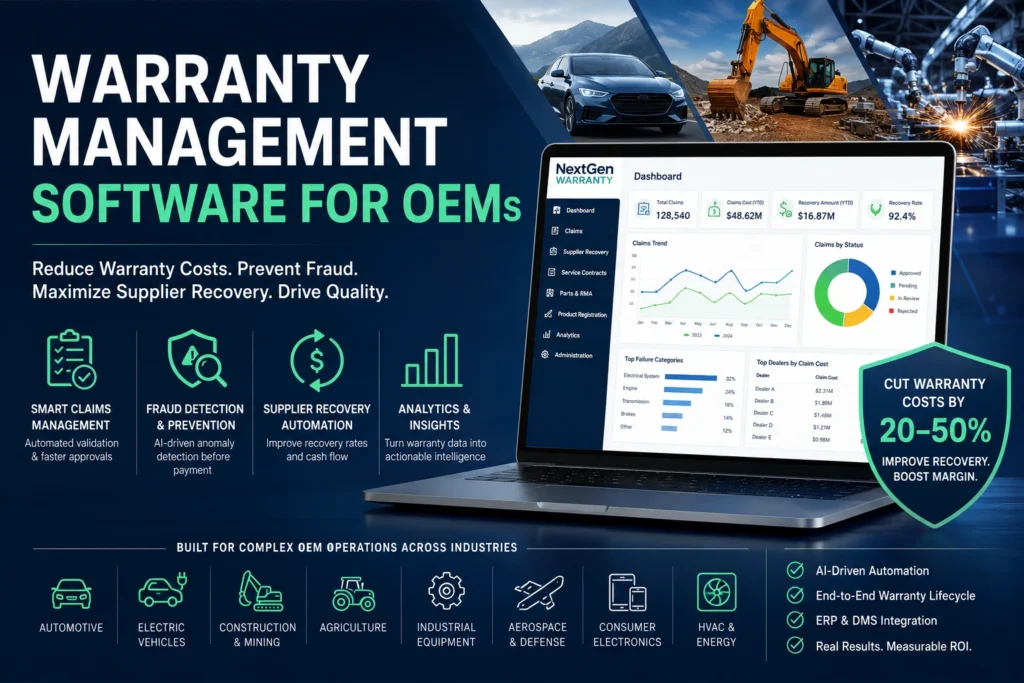
The measurable outcomes from deploying a purpose-built warranty management software fall into four categories.
Cost reduction: Manufacturers deploying AI-driven warranty management report operational cost reductions of 30% to 50%, according to Copperberg’s 2026 analysis. The savings come from stopping over-approvals, catching fraud before payment, and recovering supplier-liable costs that were previously absorbed. McKinsey’s analysis of manufacturers using advanced warranty analytics found that leading companies captured up to 30% of warranty costs through analytics-driven quality improvements.
Processing speed: Processing times have dropped by 70% to 90% with AI-driven validation, according to Copperberg. Claims that previously took days to approve move through the system in hours or minutes. Dealers get faster reimbursement. Dispute rates decline because approval decisions are consistent and explainable.
Supplier recovery improvement: Automated recovery processes increase supplier recovery rates from under 60% to above 90%. For mid-to-large OEMs, the financial impact is typically measured in millions of dollars each year.
Engineering intelligence: When warranty data feeds directly into engineering review processes, quality defects get caught earlier. Ford’s Integrated Vehicle Systems initiative used remote reprogramming enabled by warranty data to avoid over $100 million in module replacement costs over three years. Ford also developed a predictive maintenance model that prevented over 122,000 hours of vehicle downtime and saved an estimated $7 million through proactive maintenance interventions.
Warranty complexity varies significantly by industry. Here is what it looks like across the sectors where purpose-built warranty platforms have the most impact.
This is the most common decision OEMs face when evaluating warranty systems. Most manufacturers already have an ERP, and most ERPs include a warranty module. The question is whether that module is sufficient.
For most OEMs handling higher claims volumes, the short answer is no.
ERP warranty modules were built to handle financial transactions: record a claim, post a liability, and process a payment. They were not built to validate labor times against flat-rate manuals, detect fraud patterns across dealer networks, automate supplier recovery chargeback cycles, or surface failure trends for engineering review. These are not features that ERP vendors added and then removed. They were never the design intent.
The practical consequences are predictable. OEMs running warranty on ERP modules end up with spreadsheets filling the gaps. Fraud detection happens through periodic manual audits, if at all. Supplier recovery relies on individuals remembering to file claims before deadlines. Engineering learns about field failures from customer complaints, not from structured warranty data.
The integration question also gets raised frequently: if we buy a warranty platform, does it replace our ERP? No. A purpose-built warranty system integrates with the ERP through APIs. Approved payments post to the general ledger. Parts validate against the live parts master. Supplier recovery transactions link to procurement records. The warranty platform adds the specialized capabilities the ERP was never designed to provide, without displacing the financial infrastructure already in place.
NextGen Warranty integrates with SAP, Oracle, and Microsoft Dynamics through standard bi-directional APIs. For OEMs running any of these systems, the integration path does not require adopting a separate CRM platform. Approved payments post directly to the general ledger, parts validate against the live ERP parts master, and supplier recovery transactions link to existing procurement records.
The value of a warranty management platform comes from improving control, visibility, and decision-making across the entire warranty lifecycle. Instead of relying on manual processes and disconnected systems, OEMs can manage claims, recovery, and analytics within a single, structured environment. The return on investment typically comes from four key areas:
Automated policy enforcement ensures that every claim is validated against warranty terms at the point of submission. This reduces over-approvals, inconsistencies across regions, and unnecessary payouts.
Pre-payment checks identify unusual claim patterns, duplicate submissions, and unsupported repairs before they are approved, helping prevent leakage rather than detecting it after the fact.
Structured workflows and clear attribution of failures improve the recovery of supplier-liable costs. Instead of relying on manual follow-ups, recovery becomes a consistent and trackable process.
Warranty data is transformed into actionable insights. Recurring failure patterns can be identified earlier, enabling faster corrective action and reducing future claim volume.
Beyond cost control, warranty platforms simplify day-to-day operations by:
For most OEMs, the impact is visible quickly. Improvements in claim accuracy, recovery, and process efficiency translate into measurable financial and operational gains within a relatively short timeframe.
NextGen Warranty is a purpose-built warranty management software for OEM manufacturers. It covers the full warranty lifecycle: product registration, claims management, supplier recovery, service contracts, parts returns and RMA, and closed-loop analytics.
The platform serves OEMs across automotive, construction and mining, electric vehicles, consumer electronics, industrial equipment, agriculture, aerospace and defense, and HVAC and energy. It connects to existing ERP systems through standard APIs, so approved payments post directly to the general ledger, and parts validate against the live ERP parts master. For OEMs running SAP, Oracle, or Microsoft Dynamics, the integration path does not require adding a separate CRM platform as a prerequisite.
On the claims side, NextGen Warranty automates validation and adjudication with configurable business rules. Warranty managers can update policy parameters, billing rates, and approval thresholds through an admin panel without requiring developer involvement. Dealer portal access is available on web and mobile, with real-time claim status, documentation upload, and notification workflows that reduce support call volume.
Supplier recovery in NextGen Warranty is automated from the point of claim approval. Recovery claims are generated based on root-cause data, tracked through multi-round electronic negotiation, and reconciled against original claims with a complete audit trail. NextGen Warranty customers report supplier recovery rates above 90% and a 3x improvement in recovery speed compared to prior manual processes.
The fraud detection layer uses statistical anomaly scoring against claim-level, dealer-level, and VIN-level baselines. Claims that deviate from expected patterns are routed to a review queue before payment, with the specific anomaly flagged. This approach catches the patterns that rule-based filters miss, such as consistent labor inflation by a specific dealer, VINs appearing at multiple service centers with near-identical complaints, or parts claims that do not match the vehicle’s production BOM.
NextGen Warranty has delivered a 50% reduction in claims costs and 75% faster processing for customers across six continents. Mahindra’s aftersales team reported a 40% increase in supplier recovery rate within the first quarter after going live on the platform, completing implementation in under eight weeks.
If you are evaluating warranty management software, these are the criteria that distinguish systems that deliver sustained ROI from those that underperform after implementation.
Warranty management is not a back-office function that can run adequately on spreadsheets and ERP modules once your claims volume crosses a certain threshold. It is a direct driver of margin, dealer relationships, supplier cost recovery, and product quality feedback. The manufacturers treating it that way are reducing warranty costs by 20% to 30%, recovering supplier costs they were previously absorbing, and giving engineering the field data needed to fix root causes before claims compound.
The starting point is a warranty system designed for what OEM warranty operations require: automated claims validation, pre-payment fraud detection, supplier recovery automation, and closed-loop analytics that connect the service network to product development.
If your OEM processes significant warranty volume and you suspect the operation is leaking margin to inconsistent approvals, missed supplier recoveries, or undetected fraud, a working demo with your actual claim types and supplier structures will show you where the gaps are faster than any feature comparison document.
Ready to take control of your warranty costs with a smarter, AI-driven approach? Schedule a Demo with NextGen Warranty experts to get started
How long does implementation take?
Implementation timelines vary based on ERP complexity, data migration scope, and dealer network size. OEMs with well-organized master data in their ERP and a clear warranty policy structure can go live in eight to twelve weeks. The key variable is data readiness, not platform complexity.
Does warranty management software replace our ERP?
No. Purpose-built warranty platforms integrate with your ERP through bi-directional APIs. They add claims validation, fraud detection, supplier recovery, and analytics capabilities that ERP systems were not designed to provide. The ERP remains the system of record for financial transactions. NextGen Warranty connects to SAP, Oracle, and Microsoft Dynamics without requiring your team to rearchitect the existing stack.
Can a warranty platform handle EV-specific requirements?
Yes, if built for EVs. It should support battery warranties, OTA claims, and telematics-based validation, which legacy systems often lack.
Book a 30-minute walkthrough tailored to your industry.
Schedule a Demo