May 14, 2026
A conventional powertrain warranty claim follows a well-worn path. A dealer identifies a fault, submits a claim with a fault code, and the OEM validates it against coverage rules. For internal combustion engine vehicles, this process has been refined over decades. The data inputs are predictable, the failure modes are documented, and most claims management systems handle them adequately.
EV battery warranty claims do not follow that path. The failure modes are different, the data required to validate a claim is different, and the timelines involved are far longer. OEMs that attempt to run EV battery warranty claims through systems built for ICE vehicles end up with high denial error rates, unresolved disputes with dealers, and significant financial exposure from claims they cannot accurately adjudicate.
In an ICE vehicle, a component either works or it does not. A failed fuel injector throws a fault code. A cracked head gasket produces measurable symptoms. EV battery degradation does not work this way.
Battery capacity declines gradually over time and charge cycles. A customer claiming reduced range may have a legitimate warranty concern or may be experiencing normal degradation that falls within the OEM’s acceptable loss threshold. Adjudicating that claim requires State of Health data pulled from the vehicle, compared against the OEM’s degradation curve for that specific battery chemistry and usage profile.
According to a 2023 report by the International Council on Clean Transportation, most major EV OEMs define battery capacity warranty coverage at around 70 percent of original capacity over 8 years or 100,000 miles, the federal minimum for batteries in EVs sold in the US. But the claims process for proving that the threshold has been crossed requires structured telemetry data that many warranty management systems are not built to ingest or evaluate.
EVs receive over-the-air software updates that can change vehicle behavior, charging behavior, and battery management parameters. When a customer reports a fault following an OTA update, the warranty question is not about a physical component failure. It is about whether a software state created by the OEM caused a customer-facing problem.
This is a claims category that does not exist in traditional warranty frameworks. There is no physical part to return, no supplier to recover from, and no labor operation to reimburse. Yet the OEM still carries liability for the outcome. Warranty management for EV OEMs needs claim types and adjudication workflows built specifically for software-related complaints.
A battery that degrades faster than expected because a customer exclusively used DC fast charging is a different situation from one that degrades on a standard charging cycle. Whether that distinction matters legally depends on the warranty terms, but it always matters operationally. To adjudicate fairly and defensibly, OEMs need charging session data, not just odometer readings.
The US Department of Energy’s Vehicle Technologies Office has documented that real-world EV battery performance varies significantly based on climate, usage patterns, and charging behavior. An electric vehicle warranty management system needs to account for these variables at the claim level, not just at the policy level.
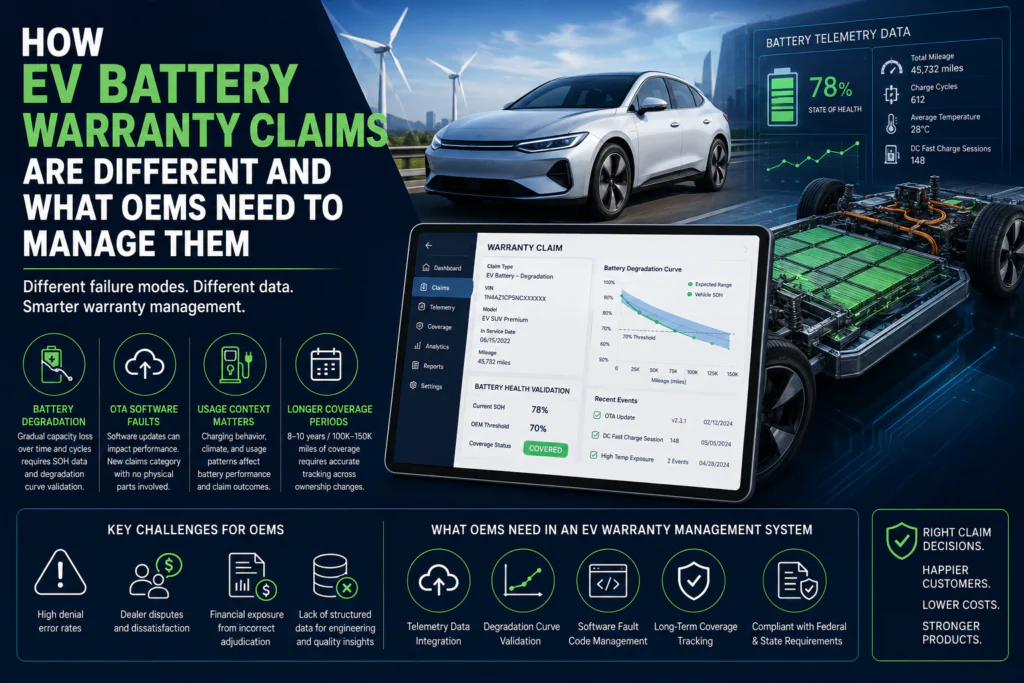
The most important input for an EV battery warranty claim is vehicle telemetry: State of Health readings, charge cycle counts, temperature exposure history, and peak charge events. This data typically lives in the OEM’s connected vehicle platform or telematics backend.
Warranty management software for EV OEMs must be able to pull that telemetry data into the claim record at the point of adjudication. Without it, a claims adjudicator is working with dealer-reported symptoms and no objective measurement of battery condition.
Each battery chemistry and pack design has a unique degradation curve. The system adjudicating the claim needs to compare the vehicle’s current State of Health against the expected range for its age, mileage, and charge cycle count, not against a flat threshold.
This is not a manual calculation. At volume, OEMs processing thousands of EV battery warranty claims per month need automated degradation validation built into the claims workflow.
OTA-related claims require a different claim type taxonomy. The system needs to support fault codes that reference software versions and update events, not just physical part numbers. Without this, EV-specific faults get misclassified or rejected, creating dealer disputes that are expensive to resolve.
Federal law in the US requires battery warranty coverage of at least 8 years or 100,000 miles for EVs sold after 2010, and California mandates 10 years or 150,000 miles under its own standards. This is two to three times the typical powertrain warranty period for ICE vehicles. Warranty management systems need to track coverage accurately over this extended timeline, including any secondary owners following a vehicle sale.
According to J.D. Power’s 2023 US Electric Vehicle Experience Ownership Study, battery and charging issues rank as the top reported problem area among EV owners. OEMs that cannot process those claims efficiently face both financial and reputational costs.
NextGen Warranty’s platform is built to handle the claims structures that EV OEMs actually face. The system supports configurable claim types that accommodate software fault codes and telemetry-based inputs alongside traditional part-and-labor claims. Coverage rules can be set to match federal and state-specific battery warranty requirements, including secondary owner coverage tracking.
Degradation validation workflows allow OEM teams to define battery health thresholds by model and pack configuration, and the system flags claims where telemetry data confirms coverage eligibility versus those where the data indicates normal degradation. This eliminates the manual review burden on adjudication teams and reduces dealer dispute rates.
NextGen Warranty’s EV capabilities are available for OEMs managing battery warranties, OTA fault claims, and charging system coverage across their dealer networks.
An EV OEM that cannot adjudicate battery claims accurately pays in multiple ways. Overclaiming dealers get reimbursed for claims that do not meet coverage criteria, adding direct warranty costs. Underclaiming customers receive denials on legitimate battery issues, generating regulatory scrutiny and customer attrition. And without structured claims data, the engineering team never gets the failure signal it needs to address recurring battery performance problems before they generate the next wave of claims.
The shift to EVs is not just a product change for OEM after-sales teams. It is a systems change. The warranty infrastructure needs to match the product it is covering.
EV battery warranty claims involve battery degradation, telemetry data, OTA software issues, and charging behavior analysis, unlike traditional ICE vehicle claims that rely mainly on fault codes and physical part failures.
OEMs need vehicle telemetry data such as State of Health (SOH), charge cycles, temperature exposure, charging history, and software update records to accurately adjudicate EV battery warranty claims.
Electric vehicle warranty management software automates battery degradation validation, integrates telemetry data, tracks long-term coverage, and manages OTA-related claims to reduce disputes and improve claim accuracy.
Book a 30-minute walkthrough tailored to your industry.
Schedule a Demo