September 4, 2026
Warranty claims management is the process an OEM uses to receive, validate, approve, and pay warranty claims filed by dealers, service centers, or customers, while recovering eligible costs from suppliers. It runs from the moment a claim is submitted through final settlement and closed-loop product feedback.
This article covers the full warranty claims lifecycle, the standard claims workflow and approval process, the recurring problems OEMs run into during claim processing, and the specific ways warranty claim automation reduces cost, cycle time, and fraud. It closes with what to look for in a claims workflow platform built for OEM scale.
Warranty claims management is the structured process an OEM uses to receive a claim, verify coverage and fault details, approve or reject it, pay the dealer or customer, and recover eligible costs from the responsible supplier. It combines policy rules, claim data, and workflow software into one repeatable process.
The process sits at the intersection of finance, service operations, and product engineering. A dealer or service center files the claim, the OEM’s warranty team checks it against coverage terms, and once approved, the claim is paid and, where applicable, the related cost is pushed back to the parts supplier for recovery.
Why it matters to the bottom line: warranty is not a fixed cost. It moves with product quality, dealer discipline, and how tightly the OEM controls claim processing.
Industry-wide, warranty expense runs between 1.3% and 1.8% of product sales for U.S. manufacturers, based on 16 years of claims data tracked by Warranty Week. For a mid-size OEM, even a small percentage swing in that number represents millions of dollars a year.
The warranty claims lifecycle runs through five stages: product registration and coverage setup, claim submission, validation and adjudication, payment and parts recovery, and analytics feedback into product design. Each stage passes data to the next, so a gap early in the cycle causes delays or overpayment later.
When any one of these stages runs on a separate system or a spreadsheet, the OEM loses the connective data that makes the next stage fast and accurate. That is usually where warranty claims management breaks down in practice.
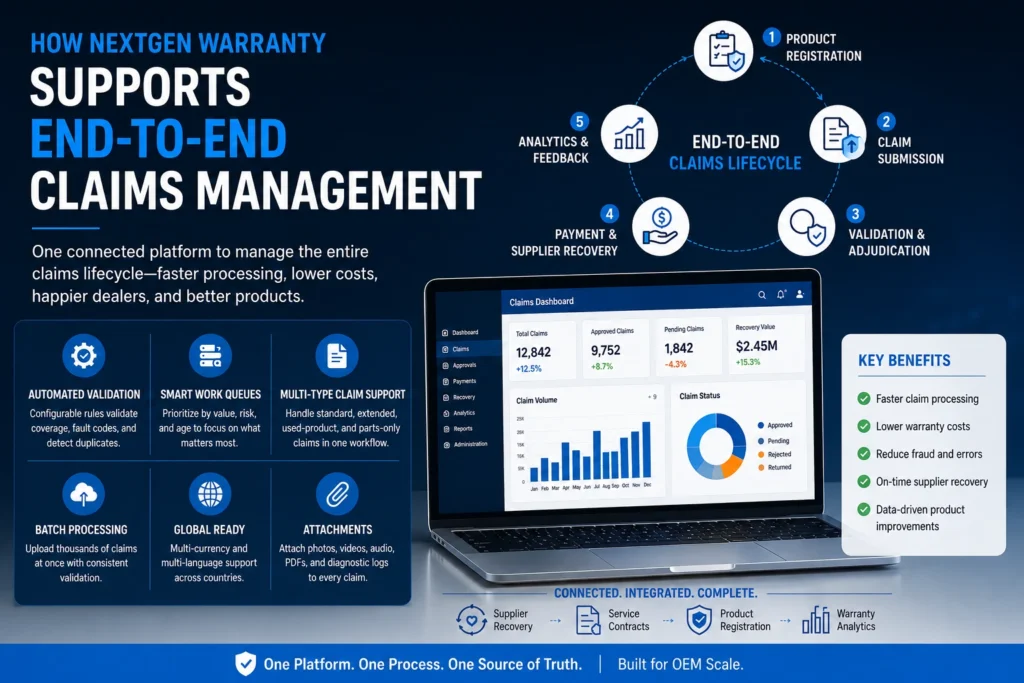
A typical claims workflow moves a claim through intake, automated validation, adjudication, repair authorization, payment, and supplier recovery. Claims that fail validation route automatically to a review queue instead of stalling the entire process for every submission.
This claims workflow is only as fast as its slowest manual step. Most delays happen at validation and adjudication, which is exactly where automation strategies deliver the fastest return.
The approval process is the stage where a claim is checked against warranty terms, fault codes, labor times, and parts pricing before it is approved, rejected, or approved with modification. Approval authority is typically tiered by claim value, with high-value or high-risk claims escalated for manual review.
A defensible approval process usually checks the following before a claim is paid:
When these checks run manually, claim value and reviewer workload usually decide the queue order, which means small claims can sit as long as large ones. A tiered, rules-based approval process fixes that by routing straightforward claims to auto-approval and reserving human review for the claims that actually carry risk.
OEMs managing claim processing manually face slow cycle times, inconsistent approvals across regions, missed supplier recovery deadlines, and limited visibility into failure trends. These issues inflate warranty spend and strain dealer relationships, since delayed reimbursement is a frequent source of dealer complaints.
On the fraud point specifically: fraudulent or erroneous claims can run as high as 10% to 15% of total submissions in warranty programs without strong claim validation, per an analysis by Redlist.
Warranty claim automation replaces manual review with configurable business rules that validate coverage, flag duplicate or suspicious claims, and route exceptions to the right reviewer. It shortens the time between claim submission and payment while cutting the share of erroneous claims that get approved by mistake.
Specifically, automation addresses:
Building an automated claims workflow starts with standardizing claim data, then layering rules-based validation, prioritized work queues, and automated supplier recovery on top. OEMs that sequence these steps in this order see faster wins before tackling harder problems like fraud scoring and analytics.
None of these steps require replacing dealer-facing systems overnight. Most OEMs start with validation and work queues, since that is where claim processing delays are most visible, then expand into recovery automation and analytics once the core workflow is stable.
NextGen Warranty is a warranty management software built to run the full claims lifecycle in one connected system, from product registration through claim processing to supplier recovery and analytics. It is designed specifically for OEM-scale claim volume rather than general customer support ticketing.
The claims management module includes:
Beyond claims processing, the platform connects to supplier recovery (auto-generated recovery claims with electronic negotiation), service contracts, product registration, and warranty analytics, so claim data feeds a single closed-loop system instead of sitting in a silo.
Warranty claims management determines how much of an OEM’s revenue warranty actually consumes. A clear claims lifecycle, a defined workflow, and a disciplined approval process keep claim processing fast and consistent, while automation removes the manual bottlenecks that drive up cost, invite fraud, and delay supplier recovery.
The OEMs that get the most value treat claims data as a shared asset: it pays dealers accurately, recovers costs from suppliers on time, and feeds product engineering the failure patterns that reduce the next wave of claims. Platforms like NextGen Warranty bring these pieces together in one system, so claim processing, supplier recovery, and analytics run off the same data instead of three disconnected tools.
Streamline Warranty Claims with NextGen Warranty
Automate claim validation, approvals, supplier recovery, and analytics in one connected platform. Book a demo to see how NextGen Warranty simplifies end-to-end warranty claims management.
Warranty claims management focuses specifically on the claim lifecycle: submission, validation, approval, payment, and recovery. Warranty administration is broader and includes setting up coverage terms, managing service contracts, registering products, and running the overall warranty program. Claims management is one core function inside the larger warranty administration process.
There is no single industry benchmark, since it depends on claim complexity and product type. As a general guide, straightforward claims that pass automated validation should clear in minutes to a day. Claims requiring manual review or supplier investigation commonly take several days to a few weeks. The goal of a good claims workflow is to keep routine claims fast so reviewer time goes to the claims that actually need judgment.
Common reasons include the product being out of the coverage window, missing or inconsistent documentation, a fault code that does not match the reported symptom, labor or parts costs above approved rates, or the repair being performed by an unauthorized service location. Many denials are avoidable with clearer claim submission requirements at the dealer level.
Automation applies consistent rules to every claim, so patterns like duplicate submissions, mismatched fault codes, or repeated claims from the same service location are flagged before payment instead of after. This does not eliminate the need for human review on complex cases, but it removes the guesswork from routine validation and creates an audit trail for every decision.
Most modern claims workflow platforms support batch uploads and system integrations so dealers can keep using their existing service or DMS systems while claims still flow into a centralized validation and approval process. This avoids forcing every dealer onto a new interface while still giving the OEM one connected view of every claim.
Book a 30-minute walkthrough tailored to your industry.
Schedule a Demo