July 10, 2026
AI in automotive warranty management refers to the application of machine learning, natural language processing, and predictive analytics to automate and improve warranty claim processing, fraud detection, failure pattern analysis, and cost forecasting. OEMs are deploying these capabilities within warranty management software platforms to reduce administrative burden, accelerate claim cycle times, and surface quality insights earlier than traditional reporting allows. AI functions as an augmentation layer, improving the speed and consistency of human-driven warranty operations, not replacing the governance, judgment, and policy expertise that remains essential to effective warranty management.
Automotive warranty management encompasses the full lifecycle of activities that govern how OEM warranty obligations are administered, from initial claim creation and eligibility validation through adjudication, payment, root cause analysis, supplier recovery, and reserve reporting. For most OEMs, this involves thousands of claims per day flowing through dealer networks across multiple markets, each governed by complex policy rules, regional variations, and evolving product configurations.
Historically, this process has been managed through a combination of rules-based warranty management systems, manual review queues, and experienced warranty analysts who apply policy knowledge to adjudicate edge cases. The volume of claims, the complexity of policy exceptions, and the sheer analytical burden of identifying patterns across large datasets have made this an operationally intensive function.
AI enters this landscape as a set of analytical and automation capabilities layered onto existing warranty management software. In practical terms, this means machine learning models trained on historical claim data to flag anomalies, natural language processing tools to extract structured information from unstructured repair descriptions, and predictive models that forecast failure rates and cost trajectories based on vehicle population and usage data.
Current adoption remains uneven. Large OEMs with mature data infrastructure and high-volume claim environments have moved furthest in deploying AI at scale, particularly in fraud detection and pattern analysis. Tier-two and regional OEMs are in earlier stages, with many evaluating platform capabilities rather than operating at production scale. The relationship between AI effectiveness and the maturity of the underlying warranty management system is direct: AI cannot compensate for fragmented data environments or poorly governed claim workflows.
The business case for AI in warranty management is driven by a combination of rising costs, operational complexity, and the growing analytical demands placed on warranty teams.
Industry estimates suggest warranty expense for automotive OEMs typically ranges between 2% and 7% of product revenue, with total industry warranty spend regularly exceeding $50 billion annually. Even marginal improvements in claim accuracy, fraud detection, or early failure identification translate to material financial impact.
Modern vehicles contain significantly more electronic and software-controlled components than their predecessors, creating new failure modes and increasing the diagnostic complexity of warranty claims. A conventional powertrain claim has a relatively standardized repair profile; a software-related infotainment or ADAS claim may involve ambiguous symptoms, multiple dealer visits, and contested coverage interpretations. This complexity strains traditional review workflows.
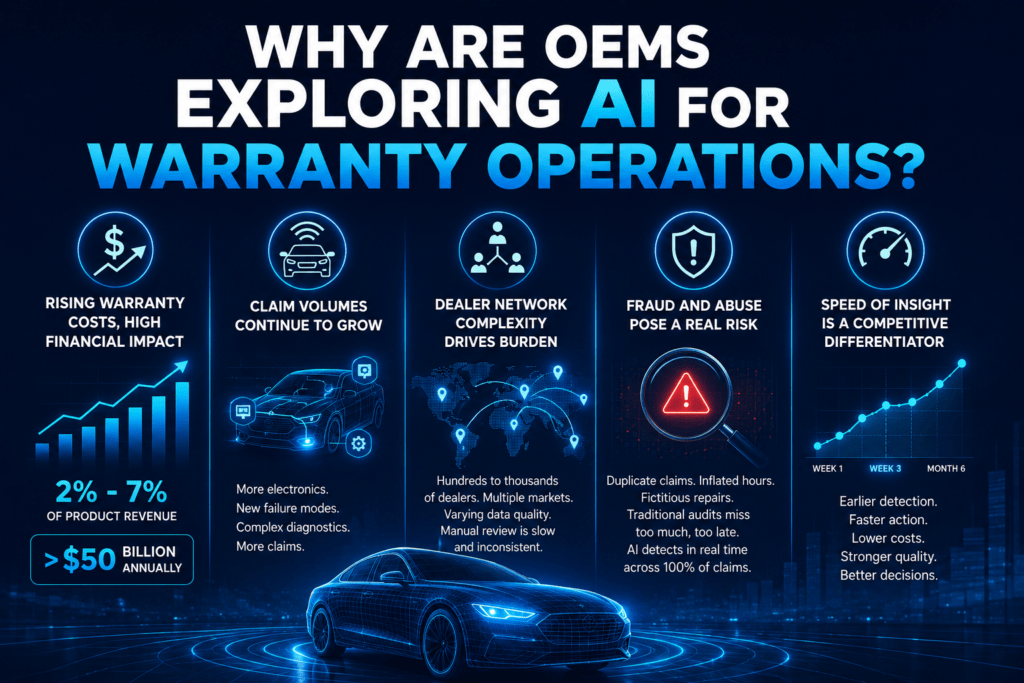
A mid-size OEM typically operates through hundreds or thousands of authorized dealers across multiple markets, each submitting claims through their own dealer management systems with varying data quality standards. Consolidating, normalizing, and reviewing this data manually is resource-intensive and introduces inconsistency.
Warranty fraud, ranging from duplicate claims and inflated labor hours to fictitious repairs, is estimated to account for a meaningful share of total warranty spend in most OEM networks, though precise figures vary widely by market and product category. Traditional auditing approaches identify fraud retrospectively and at low detection rates. AI-based pattern recognition operates across the full claim population in real time.
Quality teams that can identify an emerging failure pattern in week three of a new model launch rather than month six are able to engage suppliers, initiate containment actions, and adjust reserve forecasts before costs escalate. Traditional reporting cycles are too slow to support this kind of response.
These pressures have made warranty operations a priority area for digital transformation investment, with AI-enabled warranty management software at the center of most current initiatives.
The first-line validation of warranty claims, confirming vehicle eligibility, matching repair codes to covered components, verifying that documentation is complete, and checking that labor times fall within policy norms, is the highest-volume, most repetitive task in warranty operations.
AI can automate a substantial portion of this validation work. Machine learning models trained on historical approved and rejected claims learn to recognize the characteristics of compliant submissions, flagging incomplete documentation, mismatched repair codes, or labor hours that deviate from established benchmarks. Natural language processing tools can parse technician repair narratives, often submitted in abbreviated or inconsistent format, to extract structured diagnostic information that supports eligibility assessment.
The practical outcome is a tiered review queue in which straightforward, low-risk claims clear automatically, while claims with anomalies or elevated complexity are routed to human reviewers. This concentrates analyst attention where judgment is actually required rather than distributing it uniformly across thousands of routine submissions.
It is important to be precise about what AI validates and what it does not. Automated validation confirms that a claim is formally complete and consistent with documented policy parameters. It does not interpret ambiguous policy language, adjudicate disputes, or make coverage determinations in novel fact patterns. Those functions remain firmly in the domain of experienced warranty personnel.
Warranty fraud detection is among the most mature and operationally impactful AI applications in warranty management. The core capability is pattern recognition at scale, identifying statistical anomalies and behavioral signals across the full dealer network that would be invisible or extremely difficult to detect through manual sampling.
AI-based fraud detection identifies several distinct risk categories. Duplicate or near-duplicate claims, meaning the same repair is submitted multiple times or across related vehicles, can be flagged through similarity matching across the claim database. Dealer-level anomalies, such as unusually high claim rates for specific parts, labor times that consistently exceed benchmarks, or repair patterns that differ materially from comparable dealers in the same market, are surfaced through comparative analysis. Temporal patterns, such as a sudden increase in claims for a specific component shortly before warranty expiration, may indicate coached claiming behavior.
The key distinction from traditional auditing is one of coverage and timeliness. Traditional fraud controls sample a small percentage of claims and identify fraud retrospectively. AI systems operate across 100% of claims in real time, enabling intervention before payment rather than recovery after the fact.
A critical limitation: AI fraud detection generates hypotheses, not conclusions. A flagged dealer may have legitimate reasons for an unusual claim pattern, such as a localized environmental factor, a concentration of high-mileage vehicles in their service area, or a specific technical issue affecting vehicles sold in that region. Every flag requires human investigation before action is taken.
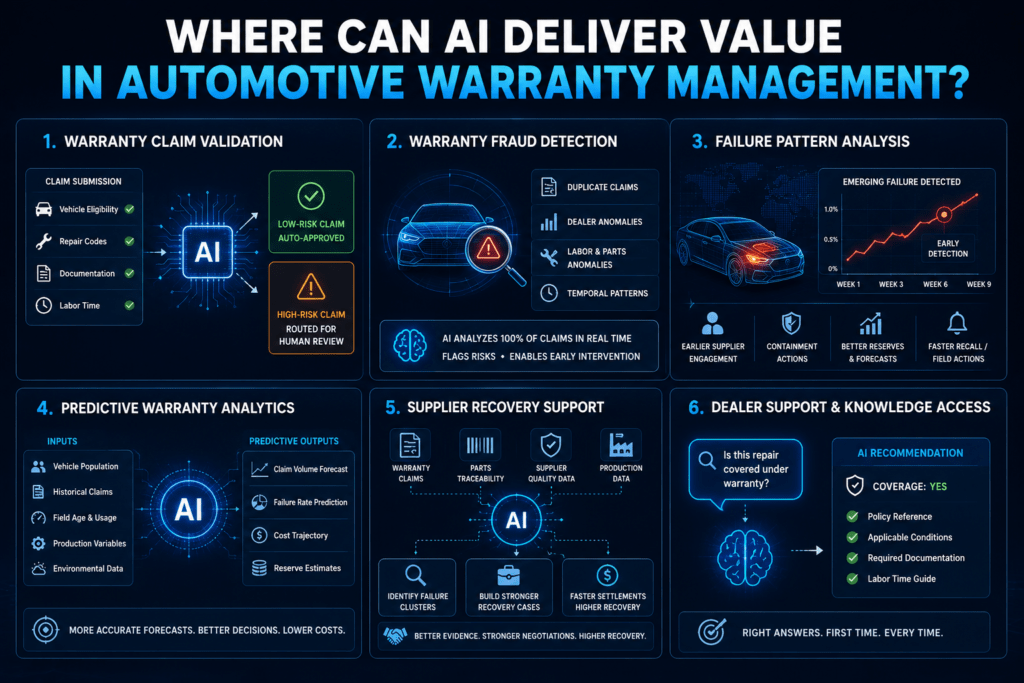
The analytical identification of emerging product quality issues, including components failing at higher-than-expected rates, failure modes concentrated in specific production batches or geographic markets, or new failure patterns emerging in the early field population, is one of the highest-value applications of AI in warranty management.
Traditional warranty reporting cycles aggregate claim data monthly or quarterly and surface issues that have already accumulated high cost. AI-based failure pattern analysis operates on the continuous claim stream, applying statistical models to detect anomalies against expected failure baselines. An emerging issue affecting 0.3% of a production cohort may be invisible in aggregate data for months; a model tuned to detect rate deviations against expected baselines may surface it within weeks of the first claims entering the system.
Early detection has compounding benefits. Quality engineering teams can engage suppliers earlier, with more specific data. Containment actions can be initiated on vehicles still in dealer inventory. Reserve forecasts can be updated before costs materialize. Recall or field action decisions can be made with better population-level data.
The accuracy of failure pattern analysis is directly tied to the quality of diagnostic coding at the dealer level. If repair codes are entered inconsistently, or if technicians use generic codes to avoid rejection risk, the signal quality available to AI systems is degraded. This is a workflow and governance challenge as much as a technology one.
Predictive warranty analytics applies statistical modeling to forecast future claim volumes, failure rates, and cost trajectories based on vehicle population characteristics, historical failure data, field age distributions, and production variables.
For warranty reserve management, one of the most financially sensitive functions in OEM warranty operations, predictive models offer a material improvement over traditional actuarial approaches, which typically rely on historical averages applied to current vehicle populations. Machine learning models can incorporate a wider range of predictor variables, including component supplier changes, production process variations, environmental exposure data, and early field return rates, producing more granular and responsive reserve estimates.
Predictive analytics also supports capacity planning for dealer service networks, supplier recovery negotiations where projected lifetime failure costs are relevant to settlement discussions, and product development feedback loops.
The outputs of predictive models should be treated as probabilistic estimates, not certainties. Model accuracy degrades when vehicles are used in conditions or geographic markets that differ significantly from the training data, when product configurations change substantially, or when new failure modes emerge with no historical precedent. Reserve managers should maintain human oversight of model outputs and apply judgment about factors that models cannot fully capture.
A significant share of warranty costs in most OEM programs is attributable to component failures caused by supplier defects. Recovery of these costs, through warranty reimbursement, engineering claims, or commercial negotiations, requires assembling detailed evidence linking field failures to specific supplier parts, production batches, and manufacturing process variables.
AI accelerates supplier recovery by automating the aggregation and linkage of warranty claim data, parts traceability records, supplier quality data, and production logs. Pattern detection models that identify supplier-linked failure clusters also support the construction of recovery cases with stronger statistical foundations than manual analysis typically produces.
The practical impact is a more systematic and better-documented warranty supplier recovery process, with earlier identification of recovery opportunities and reduced dependence on manual data assembly. Recovery rates and settlement timelines improve when OEM warranty teams enter negotiations with comprehensive, well-structured evidence packages.
AI-powered knowledge tools, including search and retrieval systems trained on warranty policy documents, technical service bulletins, repair guidelines, and claims history, can materially improve the quality and consistency of dealer warranty submissions at the point of claim creation.
When a service advisor or warranty administrator can query a system in natural language and receive a specific answer about coverage eligibility for a particular repair scenario, the probability of a compliant, first-time-correct claim increases. This reduces rejection rates, rework cycles, and the administrative burden on both dealer and OEM warranty teams.
This application is relatively straightforward from a technical standpoint but has significant operational leverage. A meaningful share of warranty claim rejections and rework in most OEM networks stems from policy misinterpretation at the dealer level rather than fraudulent intent. Improving access to accurate policy guidance addresses this systematically.
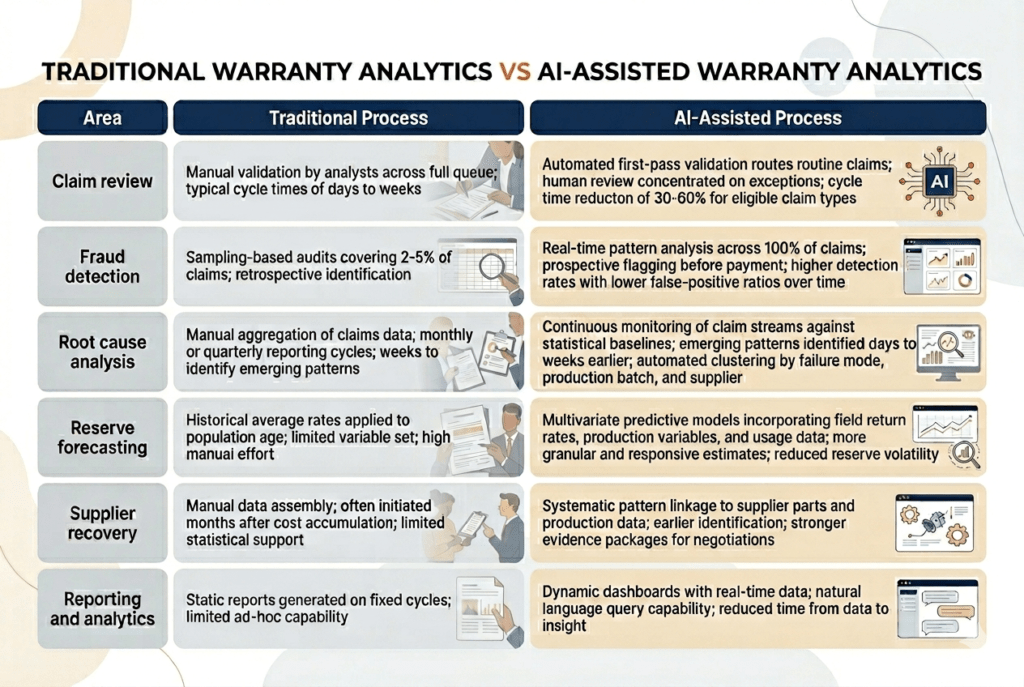
The following table illustrates the contrast between traditional manual processes and AI-assisted approaches across key warranty operations functions. Benefit ranges are based on patterns observed across industry implementations and should be treated as illustrative rather than as guaranteed outcomes. Actual results depend heavily on data quality, implementation approach, and organizational readiness.
Beyond process-level improvements, OEMs that deploy AI effectively in warranty operations report several broader benefits: better cross-functional alignment between warranty, quality, and engineering teams as a result of faster and more specific failure data; improved dealer relationships through faster claim processing and better policy guidance tools; and more defensible reserve positions in financial reporting.
The limitations of AI in warranty management deserve substantive treatment. The credibility of any AI capability assessment depends on honest engagement with what the technology cannot do and the consequences of overstating its reliability.
This is the single most important constraint on AI performance in warranty operations, and it is consistently underweighted in vendor discussions and implementation planning.
AI models are only as good as the data they are trained on. Automotive warranty environments typically involve significant data quality challenges: incomplete claims with missing diagnostic codes or repair narratives; inconsistent data entry practices across dealer networks; legacy warranty management systems with limited data standardization; and historical data collected under different coding frameworks that may not be compatible with current taxonomy.
When training data contains systematic errors or omissions, for example when a particular failure mode has been coded under three different repair codes across the dealer network, AI models learn patterns from flawed data and produce flawed outputs. The models do not flag their own uncertainty; they generate outputs that appear authoritative.
Data quality investment is a prerequisite for AI investment, not a parallel workstream. Organizations that deploy AI before cleaning their data and establishing data governance standards will underperform relative to expectations and may generate misleading outputs that erode confidence in AI tools more broadly.
Warranty policy documents are complex, frequently updated, and contain language that requires interpretive judgment rather than literal rule application. A technician repairs a component that is clearly defective, but the failure mode is ambiguous between a covered warranty condition and a customer-induced damage exclusion. The policy language is not dispositive. A senior warranty analyst with product knowledge, field experience, and familiarity with OEM adjudication precedents makes a judgment call.
AI systems are not well-suited to this kind of contextual interpretation. They can apply explicit rules reliably and flag claims that match patterns associated with prior adjudications. They cannot reliably navigate novel policy interpretation scenarios, apply judgment about edge cases not represented in training data, or weigh the commercial relationship implications of a coverage decision.
Deploying AI in adjudication roles without adequate human oversight creates risk on two fronts: the risk of incorrect coverage decisions and the risk of inconsistent policy application that creates legal or regulatory exposure.
Beyond policy interpretation, several warranty management functions require human judgment that AI cannot currently replicate.
Escalations and disputes. When a dealer challenges a rejection, or a customer escalates a coverage dispute, the resolution process involves negotiation, relationship management, and judgment about commercial and legal risk that is inherently human.
High-value and complex claims. Claims involving significant repair costs, multiple related failures, or ambiguous causation require experienced warranty personnel who can assess technical merit, engage engineering resources, and make judgment calls about claim resolution.
Legal and regulatory exposure. Warranty decisions with potential legal implications, including safety-adjacent failures, lemon law-adjacent situations, or claims in jurisdictions with specific regulatory requirements, require human oversight and appropriate escalation protocols.
New vehicle launches. Early-in-life claims for new models involve failure modes with no historical precedent in the AI model’s training data. Human expertise in pattern recognition and failure analysis is particularly important during these periods when AI systems have limited relevant data.
AI excels at detecting statistical anomalies and correlations in structured data. It does not understand the business context that explains those patterns.
A dealer with an anomalously high claim rate for a specific component may be flagged as a fraud risk. In reality, that dealer may service a large fleet operation whose vehicles accumulate mileage at three times the average rate, creating legitimately higher failure rates. An AI system cannot distinguish between these scenarios without additional data and human interpretation.
A failure rate uptick in a specific market may appear to indicate a component quality issue. It may actually reflect a recent change in how dealers in that market code a particular repair. AI identifies the pattern; human analysts determine whether it represents a real quality signal or an artifact of behavior change.
This is not a limitation that will be fully resolved by more sophisticated models. Business context is often tacit, relational, and not captured in structured data systems. Human oversight in the interpretation of AI outputs is not a transitional arrangement while AI matures. It is a permanent feature of responsible AI deployment.
Warranty operations in automotive OEM environments are subject to audit by financial auditors reviewing reserve adequacy, by regulators in markets with mandatory warranty disclosure requirements, and by internal governance processes. Audit requirements include explainability, meaning the ability to document why a specific claim was approved or rejected.
AI models, particularly complex machine learning models, are often limited in their explainability. A model may correctly flag a claim as anomalous without being able to generate a simple, auditable rationale that a warranty manager can document and defend.
Explainability requirements should be a hard selection criterion in evaluating AI warranty management software. Models that cannot generate human-readable explanations for their outputs are unsuitable for use in adjudication or high-stakes flagging functions, regardless of their predictive accuracy.
Perhaps the most common and consequential misconception about AI in warranty operations is that technology investment can substitute for process improvement.
AI tools amplify the efficiency and quality of well-designed processes. They also amplify the volume and velocity of poorly designed ones. An OEM with inconsistent claim intake processes, unclear escalation protocols, weak dealer training, and fragmented reporting will not gain clarity and consistency by deploying AI on top of those processes. They will gain faster, higher-volume confirmation of their existing problems.
Successful AI implementation in warranty management requires process redesign, workflow governance, and organizational alignment as co-investments with technology. This is an operations initiative that happens to use technology, not a technology initiative that incidentally touches operations.
The implementation sequence matters. Organizations that initiate AI deployment before addressing foundational data quality issues, including inconsistent coding practices, incomplete historical records, and fragmented data sources, routinely fail to achieve projected benefits and often damage internal confidence in AI tools for years afterward.
The correct sequence is to audit data quality, establish data governance standards, standardize coding practices at the dealer level, and build a clean historical dataset of sufficient size before model training begins. For most OEM environments, this work takes six to eighteen months and requires cross-functional commitment across warranty operations, IT, and dealer development.
Vendor marketing for AI warranty solutions frequently implies a degree of automation that reflects aspiration more than operational reality. Fully autonomous warranty claims processing, in which AI makes final adjudication decisions without human review, is neither technically reliable nor commercially advisable for the reasons outlined above.
The appropriate model is human-in-the-loop automation: AI handles first-pass validation and routing, generates recommendations and flags anomalies, and processes clearly compliant claims within defined parameters, while humans retain decision authority for exceptions, high-value claims, and disputes. Expectations should be calibrated to this model rather than to full autonomy.
AI capabilities in a warranty management system have no value if they are not integrated into dealer workflows in ways that dealers actually use. Dealer adoption of AI-powered tools for claim submission guidance, policy retrieval, and diagnostic support requires training, change management, and ongoing support.
OEMs that treat dealer adoption as a downstream concern rather than a core implementation workstream consistently underperform on AI benefit realization. The quality of claim data entering the system is determined at the dealer level. If dealer workflows do not improve, AI tool performance will not improve meaningfully.
AI implementation projects frequently report success metrics focused on system activity, such as the number of claims processed, the percentage of claims auto-validated, and the volume of anomalies flagged, rather than on outcome metrics that matter to the business.
The relevant metrics are warranty cost per unit, claim cycle time, fraud recovery rate, supplier recovery as a percentage of attributable warranty cost, reserve accuracy, and quality issue detection lead time. If AI deployment is not improving these numbers, it is not delivering value regardless of what system activity metrics show.
AI warranty management implementations that are owned and driven by IT organizations rather than warranty operations typically produce systems that work technically but are not used effectively. Technology designed without deep input from warranty analysts, claims managers, and quality engineers will not fit operational workflows and will not be trusted by the people responsible for warranty outcomes.
The ownership model matters. AI implementation should be led by warranty operations with technology as a supporting function, not the reverse.
NextGen Warranty is an end-to-end warranty management software platform built for OEMs, covering the full warranty lifecycle from product registration through claims management, supplier recovery, service contracts, and closed-loop warranty analytics. The platform is trusted by more than 40 OEM customers across six continents, including Mahindra, Ford, and Ather Energy, and is designed with the understanding that AI delivers the most value as an augmentation layer within structured, human-supervised workflows.
NextGen Warranty does not position itself as a fully autonomous claims processing platform. The platform’s value proposition is built on combining AI-assisted automation with structured workflows and experienced warranty team oversight, producing outcomes that neither technology nor people achieve as effectively in isolation.
AI is a genuinely powerful set of tools for automotive warranty management, capable of improving claim processing speed, fraud detection coverage, failure pattern visibility, and reserve accuracy in ways that traditional approaches cannot match. The productivity gains and cost impacts available to OEMs that implement AI effectively are material and well-documented.
But the value of AI in warranty management is conditional. It depends on the quality of the data it operates on, the governance of the processes it is embedded in, the alignment between its outputs and human decision-making workflows, and the organizational discipline to measure outcomes rather than activity. AI deployed without these foundations performs below expectations, erodes stakeholder confidence, and can produce misleading outputs that create real operational and financial risk.
The OEMs that are extracting the most value from AI in warranty operations are not the ones that have moved fastest to automate. They are the ones that have invested in data quality, aligned AI deployment with process redesign, trained their teams to work effectively with AI tools, and maintained the human oversight that complex warranty decisions require. The combination of well-designed AI capability, structured workflows, and experienced warranty professionals consistently outperforms either element alone.
If you are ready to take control of your warranty operations, NextGen Warranty offers an end-to-end platform purpose-built for OEMs, covering claims management, supplier recovery, warranty analytics, and product registration in a single connected system.
Explore how NextGen Warranty can help your team cut claims costs, recover more from suppliers, and turn warranty data into product intelligence. Schedule a demo today.
AI in automotive warranty management refers to the application of machine learning, natural language processing, and predictive analytics within warranty management software to automate claim validation, detect fraud, identify emerging failure patterns, forecast warranty costs, and improve the accuracy and efficiency of warranty operations. It functions as an augmentation layer within existing warranty workflows rather than a replacement for experienced warranty personnel or established governance processes.
AI can automate specific, high-volume, rules-based steps within the warranty claims process, including first-pass eligibility validation, documentation completeness checks, and labor time verification. Full end-to-end automation of warranty claims adjudication is neither technically reliable nor operationally advisable at this stage of AI development. The appropriate model is human-in-the-loop automation, in which AI handles routine validation and routing while humans retain decision authority for complex, high-value, and contested claims.
AI detects warranty fraud through pattern recognition and anomaly detection applied to the full claim population. This includes identifying duplicate or near-duplicate claims, detecting dealer-level statistical anomalies in claim rates or repair patterns, flagging labor times or parts usage that deviate significantly from benchmarks, and surfacing temporal patterns such as unusually high claim volumes preceding warranty expiration. AI fraud detection operates across 100% of claims in real time, compared to the 2-5% coverage of traditional sampling-based audits. All AI fraud flags require human investigation before action is taken.
The primary limitations of AI in automotive warranty management include
No. Experienced warranty managers and analysts remain essential in AI-enabled warranty operations for policy interpretation and adjudication, dispute resolution, high-value claim review, supplier negotiation, regulatory compliance, and the application of business context that AI systems cannot access.
AI improves warranty analytics by enabling continuous monitoring of the claim stream against statistical baselines, accelerating the detection of emerging failure patterns, and producing more granular and responsive reserve forecasts through multivariate predictive models. Where traditional reporting cycles operate monthly or quarterly and look backward, AI-based analytics provide near-real-time visibility into claim trends, supplier-linked failure patterns, and reserve exposure. The result is faster cross-functional response to quality issues and more accurate financial planning.
Effective AI warranty systems require structured historical claim data including vehicle identification, component and repair codes, labor times, parts used, dealer and market identifiers, and claim disposition outcomes. The minimum viable dataset for model training varies by application. Fraud detection models typically require two or more years of claims history across a meaningful population; failure pattern models require sufficient claim volume to establish reliable baselines. Data quality matters as much as volume: systems trained on inconsistently coded or incomplete data will produce unreliable outputs. Foundational data governance investment is a prerequisite for effective AI deployment.
Book a 30-minute walkthrough tailored to your industry.
Schedule a Demo