September 25, 2026
Warranty fraud detection is the set of processes and tools an OEM uses to identify warranty claims that misrepresent a repair, a failure, or an entitlement in order to collect payment the claimant is not owed. It combines claim validation rules, pattern analysis, and, in modern systems, AI-driven fraud analytics to catch bad claims before payment goes out, not after.
This article covers the common types of warranty fraud, real-world examples of how those patterns show up by industry, the detection methods OEMs use today, how duplicate claims and other patterns drive warranty leakage, the difference between pre-payment and post-payment detection, the role AI plays in fraud analytics, and the real financial impact fraud has on OEM margins.
It also covers the steps to build a fraud detection process from the ground up, a best practice checklist for prevention, the criteria to use when evaluating a fraud detection solution, and what a purpose-built warranty platform adds to that process. By the end, an OEM warranty or aftermarket team should have a clear framework for where fraud enters the claims process and how to close each entry point.
Warranty fraud detection is the process of identifying warranty claims that contain false, exaggerated, or manipulated information, either before payment or during a post-payment audit. It relies on validation rules, historical claim comparisons, and analytics to flag claims that do not match expected repair patterns, coverage terms, or documented product history.
It is a narrower discipline than general claim validation. Validation checks whether a claim is eligible: is the product under warranty, is the part covered, is the paperwork complete. Fraud detection goes a step further and asks whether the claim is truthful: did the failure happen the way it was described, has this exact repair been billed before, does the labor time match the job?
Most OEMs run both in the same claims workflow, since a claim can pass basic eligibility checks and still be fraudulent. A claim can have the correct VIN, a valid coverage window, and complete paperwork, and still describe a failure that never happened the way it was reported. That gap between eligible and truthful is exactly what fraud detection is built to close.
Warranty fraud, warranty abuse, and warranty leakage describe different problems that often get grouped together. Fraud involves intentional misrepresentation, abuse involves claims that are technically outside policy but not necessarily malicious, and leakage is the broader financial gap that fraud, abuse, and process errors all feed into.
The distinction matters for how a team responds. Fraud calls for detection, documentation, and in serious cases, network action against the dealer or service center involved. Abuse calls for clearer policy language and tighter approval criteria. Leakage calls for a broader look at the entire claims workflow, not just the claims that look suspicious.
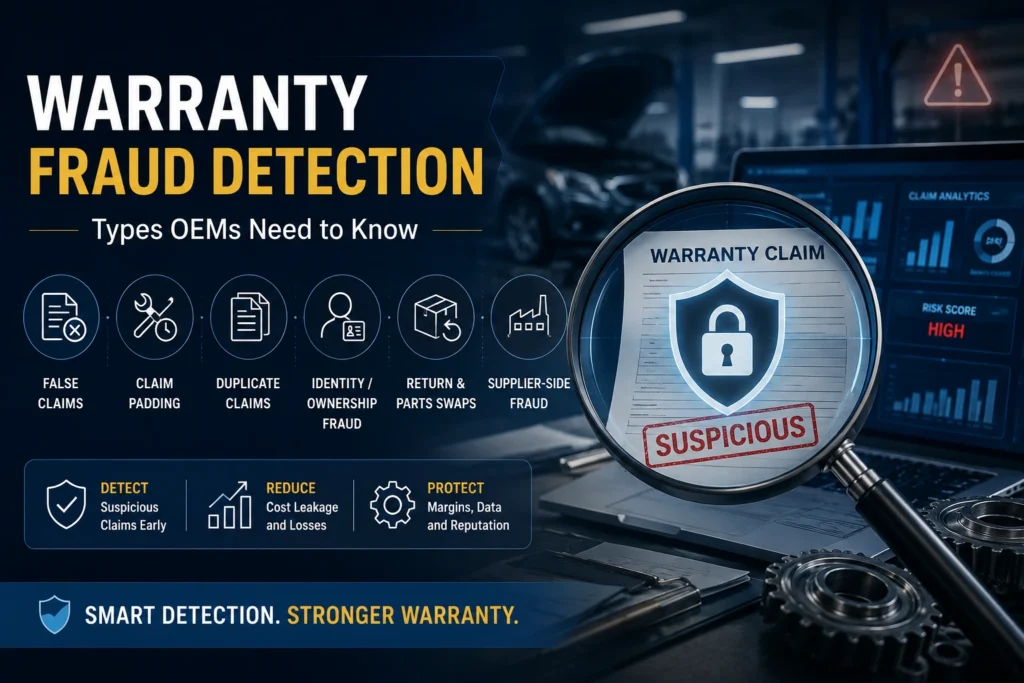
Warranty fraud generally falls into six recurring categories: false claims, claim padding, duplicate claims, identity or ownership fraud, return or parts swaps, and supplier-side fraud. Each pattern drains warranty budgets differently, but all of them move through the same claims process if validation and analytics are not in place.
A false claim reports a defect that never happened, or attributes a failure to a manufacturing fault when the real cause was misuse, accidental damage, or normal wear outside the warranty terms. This is the most straightforward fraud type to describe but often one of the hardest to prove without photo evidence, diagnostic logs, or a documented failure history for that component.
Claim padding takes a real, legitimate repair and inflates it, whether through extra labor hours, unnecessary parts, or a full replacement requested instead of the specific defective part. A laptop with one faulty key gets billed as a full keyboard replacement. A jacket with a stuck zipper gets a new lining added to the same claim. Padding is common because it hides inside an otherwise valid claim, which makes it harder to catch through simple approve or reject review.
A duplicate claim bills the same repair, part, or fault more than once, sometimes under a different date, technician name, or claim reference number. This pattern gets its own detailed section below, since it is consistently the type OEMs report catching most often once they start actively looking for it.
This occurs when a claim is filed on a unit that was not purchased by the claimant, was sold outside the authorized distribution channel, or was never properly registered under warranty. Gray-market resale and unregistered secondhand units are common entry points for this type of fraud, particularly for products with high resale value.
A customer or service center returns a counterfeit, used, or unrelated part to the OEM while keeping the genuine replacement part. This type of fraud is often invisible at the claims desk, since the paperwork looks correct. It typically surfaces later, during parts inspection or when return volumes for a specific component do not match failure rates reported elsewhere in the network.
A supplier inflates defect rates, files duplicate chargebacks against the OEM, or substitutes lower-grade components while billing for the approved part. Because OEMs often depend on supplier-reported data to validate these chargebacks, this is one of the more expensive fraud types to catch, since the brand is relying on the same party that has an incentive to misreport.
Duplicate claims occur when the same repair, part, or fault is billed more than once, either through resubmission under a different reference number or through both a dealer and a customer charging for the same fix. They are the single most frequent fraud pattern OEMs report catching once they start looking.
Duplicate claims are easy to miss manually because they rarely look identical on the surface. A claims reviewer checking one file at a time has no easy way to compare it against thousands of other claims filed in the same week. Common duplicate scenarios include:
Automated duplicate detection solves this by matching claims against unit history, date ranges, and repair codes at intake, rather than relying on a reviewer’s memory of similar cases. This is one area where volume actually helps: the more claims a system has processed, the easier it becomes to spot a match, since the comparison is done against the full claim history instead of whatever a reviewer happens to recall.
It is worth noting that not every duplicate is fraud. A claim can be legitimately resubmitted after a data entry correction, or a repair can be logged twice by accident during a dealer’s own record keeping. Good duplicate detection is built to distinguish an intentional repeat billing from an honest administrative error, typically by looking at whether the amount, timing, and description match closely enough to suggest intent rather than a clerical mistake.
Warranty fraud patterns differ by product category, but the underlying mechanics repeat across industries: mismatched documentation, inflated labor, and claims that cluster around a small number of dealers or service centers. Understanding how these patterns show up in a specific sector makes them easier to build detection rules around.
These patterns are not isolated incidents. One documented case analysis of warranty fraud across manufacturing sectors found that dealer-level mileage manipulation and duplicate billing persisted for years at one automotive OEM before analytics flagged the anomalies, and that a computer technology provider uncovered tens of millions of dollars in supplier and service-provider fraud once it moved from manual review to data-driven detection.
Warranty leakage is the gap between what an OEM should be paying out under its warranty terms and what it actually pays because of errors, fraud, or missed recoveries. Fraud is one of the largest contributors, since every fraudulent claim that clears is money paid for a repair that never should have qualified in the first place.
Warranty leakage adds up quickly at scale. NextGen Warranty estimates that most OEMs lose between 2% and 7% of product revenue to warranty claims each year, and fraud, over-approvals, and missed supplier recoveries are the three biggest drivers behind that range.
The leakage does not stop at the fraudulent payout itself. It also shows up as inflated warranty reserves, distorted failure-rate data that misleads engineering teams, and slower payments to legitimate dealers because reviewers are overloaded checking every claim by hand.
OEMs detect warranty fraud through a mix of rule-based validation, statistical pattern analysis, and machine learning models that compare each claim against historical norms. Most mature programs layer these methods together, since each one catches a different category of fraud.
None of these methods work well in isolation. Rule-based validation alone only stops fraud that someone has already anticipated and written a rule for. Statistical benchmarking alone can flag legitimate outliers, such as a dealer in a harsh climate with genuinely higher failure rates. The combination is what makes fraud detection reliable: rules catch the obvious violations, benchmarking and duplicate detection catch the repeatable patterns, and machine learning catches the patterns nobody wrote a rule for yet.
Pre-payment fraud detection screens a claim before money leaves the organization, while post-payment detection reviews claims after payment, usually through periodic audits or supplier reconciliation. Pre-payment detection is more effective, since it prevents the loss instead of trying to recover it after the fact.
Post-payment audits still have a role. They catch fraud patterns that only become visible in aggregate, such as a dealer whose approval rate looks fine claim by claim but stands out once a quarter of data is reviewed together. They are also how OEMs validate that pre-payment rules are actually working as intended.
A mature fraud detection program runs both. Pre-payment detection stops the majority of fraud before it costs anything, while post-payment audits act as a backstop and a feedback loop for improving the rules and models used upstream.
Fraud analytics uses machine learning to study thousands of past claims and learn what a normal claim looks like for a given product, dealer, or region, then flags anything that deviates from that baseline. This catches coordinated or subtle fraud that static rules and manual review typically miss.
Where rule-based systems catch obvious violations like an expired warranty or a missing invoice, AI-driven fraud analytics is built to catch patterns that only show up across large volumes of data, such as:
Manufacturers using AI-driven, pre-payment fraud detection report catching fraudulent or inaccurate claims at more than double the rate of manual review alone, since the model compares every incoming claim against the full claim history instead of a reviewer’s personal caseload.
AI does not replace human judgment on complex or disputed cases. It changes where human time goes: instead of reviewing every claim at the same depth, reviewers spend their time on the smaller set of claims the system has flagged as high risk.
Warranty fraud is not a minor leakage problem. Industry estimates put fraudulent claims at 10% to 15% of total claim volume, and unresolved fraud compounds into lost margin, inflated reserves, and distorted product quality data that engineering teams rely on to fix real defects.
Independent estimates back this up. Redlist’s analysis of OEM warranty validation puts fraudulent claims at 10% to 15% of all submissions when validation controls are weak, on top of a warranty cost base that typically runs 2.1% to 2.5% of product sales.
The scale can be severe in specific cases. One computer technology provider estimated it was losing roughly $100 million a year to warranty fraud before adopting data-driven fraud detection, according to a case study reported by Paul Curwell. After implementation, the company uncovered $11 million in fraud within nine months and an estimated $67 million in savings over five years.
Beyond the direct payout, fraud has three compounding costs that are easy to overlook:
For a finance or aftermarket leader building a business case, the financial impact of fraud detection is easiest to frame in three parts: the direct cost of fraudulent payouts avoided, the indirect cost of cleaner reserve forecasting and product quality data, and the operational cost of reviewer time freed up to focus on genuinely complex claims instead of routine screening. Most fraud detection investments are justified on the first category alone, with the other two as compounding value on top.
Building a fraud detection process starts with clean claim data and entitlement rules, then layers statistical benchmarking, duplicate detection, and machine learning on top. OEMs that follow this order catch fraud earlier without over-flagging legitimate claims and slowing down honest dealers.
Preventing warranty fraud is less about a single tool and more about closing gaps across policy, process, and technology at the same time. The following checklist covers the areas that consistently show up in fraud cases when they are missing.
Choosing a fraud detection solution comes down to how well it fits the OEM’s claim volume, network structure, and existing systems, not just its feature list. The following criteria help separate a good fit from a solution that looks strong on paper but is difficult to run day-to-day.
NextGen Warranty is a warranty management platform built to run entitlement checks, automated validation, and fraud analytics inside the same claims workflow, rather than as a separate audit step after payment. It is designed for OEM-scale claim volume, including high-volume categories where fraud detection matters most.
Fraud-related capabilities include:
OEMs evaluating a warranty fraud detection process can review the platform’s claims and analytics modules by booking a demo directly with Nextgenwarranty experts.
Claim validation checks whether a claim is eligible: is the product still under warranty, is the part covered, is the documentation complete. Warranty fraud detection goes further and checks whether the claim is truthful, using pattern analysis and analytics to catch duplicate billing, inflated labor, or fabricated failures that can still pass basic eligibility checks.
Common signs include claims filed just before coverage expires, labor hours well above the standard time for a repair, the same serial number appearing on multiple claims, a single dealer with an approval rate or claim volume far outside the regional average, and documentation that does not match the reported fault. None of these alone confirms fraud, but each one is a reason to route a claim for closer review.
No, and it is not meant to. AI-based fraud detection is built to flag the claims most likely to need a closer look, based on patterns across thousands of past claims. Manual reviewers still make the final call on flagged and disputed claims. The main change is that reviewer time goes to higher-risk claims instead of being spread evenly across every submission.
Done correctly, it speeds them up. Claims that pass entitlement checks and show no risk indicators can be validated and approved automatically in minutes. Only the smaller set of flagged claims goes to manual review, which means honest dealers and customers typically see faster payment, not slower, once fraud detection is layered into the claims workflow.
Timelines depend on data readiness more than platform complexity. OEMs with clean, centralized claim and coverage data can often go live with core validation and duplicate detection in a matter of weeks, while machine learning-based fraud scoring typically needs several months of historical claim data before it can reliably learn normal patterns. Most teams start with rule-based validation and duplicate detection first, since those deliver value immediately, then layer in analytics once the data foundation is solid.
Warranty fraud detection is not a side project bolted onto claims processing. It is a core control that determines how much of an OEM’s warranty spend is legitimate and how much is quietly leaking out through duplicate claims, padded labor, and fabricated failures. The financial impact is real and well documented, with fraud estimated at 10% to 15% of total claim volume across manufacturing sectors, layered on top of a warranty cost base that already runs 2% to 7% of product revenue.
The patterns repeat across industries, whether it is mileage manipulation in automotive, inflated service invoices in electronics, or parts swaps in industrial equipment, which is exactly why rule-based checks alone are not enough. Fraud adapts, and detection has to adapt with it through duplicate matching, dealer benchmarking, and machine learning models that learn from every new claim.
The OEMs managing this well combine entitlement checks, rule-based validation, duplicate detection, and AI-driven fraud analytics in one claims workflow, so they catch suspicious claims before payment rather than chasing them down afterward. Platforms like NextGen Warranty bring these layers together in a single system, giving warranty teams the visibility to stop leakage without slowing down the claims their dealers and customers are honestly owed.
See how NextGen Warranty helps OEMs detect duplicate claims, automate validation, and stop warranty leakage before payouts are approved. Book a personalized demo today.
Book a 30-minute walkthrough tailored to your industry.
Schedule a Demo